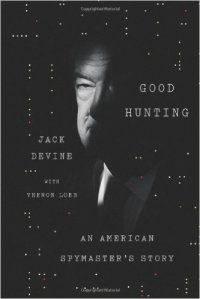
- “Our ability to pay sources for information and access was also always a bone of contention with State, which thought it gave us an unfair advantage in gaining political access and influence. CIA recruitment is based largely on the American capitalist system: namely, buying sources’ cooperation. It has been my experience that the taking of money, often because of an urgent financial need, makes sources more reliable and responsive.
Once on the payroll, they are compromised and cannot divulge the relationship without hurting themselves. This is a very important factor in controlling an asset’s potential negative behavior.
I do not believe that paying agents and other sources of information corrupts the intelligence-gathering process. As a general operating principle, we select targets who have known access to information we want. Hence, we start from a very strong position, because the source does not have to invent information to get paid. He or she already has the access. Furthermore, a high percentage of our recruitments begin with ideological identification with the United StatesMany of them either don’t identify with the political systems in their countries or have been harmed by them. The money is a reinforcing inducement, not the be-all and end-all in a source’s productivity.”
- “Our involvement in El Mercurio was this: we gave the paper roughly $2 million, but our purpose was the opposite of co-opting it. What we wanted was to ensure continued press freedom. True, there was no official censorship by the Allende government; half a dozen dailies in Santiago represented the full spectrum of political opinion, and each operated independently. However, shortly after my arrival, the government blocked El Mercurio ’s access to newsprint. This, along with cutbacks in advertising and labor unrest, threatened to shut it down, and that would have been a tremendous loss.”
- “But Chile taught me a lesson about unintended consequences that has served me well. If the coup that toppled Allende was an episode that has plagued the CIA ever since, for all the wrong reasons, my next reminder to be careful what we wished for was even more disastrous.”
- “The mujahideen, unlike the Taliban today, preferred fighting at a distance, especially against the Russians, recalled Dempsey, the former Marine captain who was my weapons specialist. They therefore required extensive experience not just with the new weapon system but in weaning themselves away from this “fire-and-run” approach.”
- “It’s rare that a single weapon changes the course of a war. I would like to say I knew when we sent the weapon out that summer that the Stinger would force the Soviets to change their rules of engagement, but I didn’t. Even after the first three Hinds were shot down, I still thought we were looking at a long, protracted campaign. Within weeks, however, Bearden and I realized that the Soviets had indeed changed tactics and were no longer willing to fly low and risk losing their gunships. The Khyber Pass became a superhighway, with guns, ammunition, and matériel pouring through, and the Soviets were suddenly powerless to stop them.”
- “From our time together in the Counter Narcotics Center, Roeber and I had begun to appreciate the value of analyzing management data. This was largely alien to the Directorate of Operations culture. If you talked to most DO officers, they would stress at some point that espionage is “an art, not a science.” That attitude tended to excuse everything—“We’re artists.” It sounds good, and I subscribed to this view for years, and a number of times used the same expression myself. But the more I thought about it, the more it seemed nonsensical. It is true that espionage had a human dimension to it that wasn’t easy to quantify. For example, how and when to pitch a target. But that didn’t mean that analyzing management data wasn’t helpful, even essential, or that we should have been immune to accountability for the sake of this “artistry.” The DO, in many ways, was almost mythic in the way it viewed itself and hated to be evaluated, resisting basic questions such as “How many people do we have here?” and “What are they doing in comparison to other offices?””
- “There had also been a long-standing tendency in the directorate to resist technology, although things have improved substantially in this area in recent years. When the Agency’s IT people first offered e-mail to the DO, nobody in the directorate would take it, but having relied on it more heavily in the CNC, I volunteered Latin America to be the guinea pig, and we were the first division to have e-mail. I don’t need to explain that, since today it is so much a part of U.S. government and private-sector communication.”
- “Another important trait in this type of environment is the ability to think strategically. I learned a lesson about effective leadership from an unlikely source when I was young. The lesson was to carve out time in my day, every day, just to think. I learned it when I was listening as a teenager to an unusually frank conversation between my father and his longtime friend Jim O’Neil, the head of Plumbers Union Local 690 in”
- “Philadelphia and the leader of all the building trades in the city. In terms of power, he was second only to the mayor, who many thought had been elected by the powerful union bosses in the early 1960s. I was fascinated to see these very strong men talking about life and leadership. They exuded strength and decisiveness. O’Neil noticed me, turned, and apropos of nothing said, “Always have a firm handshake and never have your photo taken with a drink in your hand. But most important, take the first half hour of each day to reflect and game the day.” These were simple thoughts, but they stuck with me. I have a reliable alarm in my head and almost never use an alarm clock.”
- “There were people at the Agency whose emotional and family connections to the place were so intense that we literally had to walk them to the door of headquarters on their last day. Leaving the CIA isn’t like saying goodbye at a normal workplace, where you can go back for a visit later. Once you leave the Agency, unless you are under contract or have some specific reason to go back inside the building, you’re gone. All the people working inside must by necessity become circumspect when talking to you about their activities. It is unprofessional and imprudent to press them about their work. And if you call and you do not have a specific number, the operator will not put you through. In a very real way, when you retire from the Agency you are cut off from the elite team that you had been a part of for so many years.”
- “Covert action is a large umbrella, covering everything from the kind of political action I was involved with in Chile to the proxy war I helped stage and manage in Afghanistan. The ability to make things happen in secret is something that presidents will always need, and when you are talking about achieving objectives outside war zones, covert action is almost always a highly effective tool.”
- “Social networks such as Facebook, and even Internet search engines such as Google, have profoundly changed not only the way the CIA does business but also the very meaning of that business. Part of the CIA’s traditional role has been to collect basic facts from the far corners of the globe about all the people, places, and things that matter. Now, however, a great deal of this basic information is being collected for commercial purposes, and that means that what qualifies as “intelligence” worthy of CIA collection is rapidly changing. Randall Forte, who served as assistant secretary of state for intelligence and research from 2006 to 2009, put it this way: “The rise of information searches and data aggregators like Google has led to a world where 90 percent or more of information out there is available from open sources. This dramatically restricts the areas in which clandestinely acquired intelligence is actually value-added and places the intelligence community in competition with open-sourced information. Why spend a billion dollars on a collection program that may deliver the same information as can be had for free on the Internet, only slower and with greater risks?””
 Tarek Naim's Blog
Sounds very interesting!
LikeLike
another good book indeed!
LikeLike