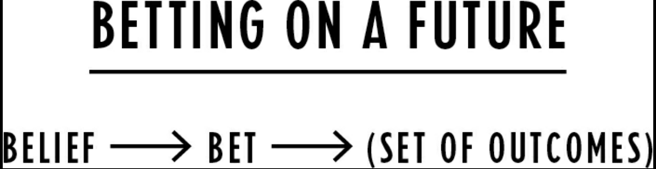
- One of the things the author learned early on as she switched careers to become a professional poker player is to understand what a bet is: a decision about an uncertain future. Treating decisions as bets allowed her to find learning opportunities in uncertain environments, learn from results, avoid common decision traps, and afforded her the opportunity to make decisions with better control of her emotions.
- The premise of this book is that Thinking in bets will allow you to make better decisions:
- Separate the decision quality from the outcome quality
- It will also introduce you to the power of saying “I’m not sure”
- It will enable you to recall your past self and combine that with your present self to make less-emotional decisions
- Learn how to map out the future
- Become less reactive
- find other truth-seekers and exchange knowledge with them to become a better decision maker.
- Thinking in bets starts with recognizing that how our life turns out depends on exactly two things: The quality of our decisions and luck. Learning how to recognize the difference between the two is what thinking in bets is about.
- Pete Carroll took heat for his decision in the last seconds of the Super Bowl in 2015. All pundits questioned “what he on earth he was thinking with the worst play call in the NFL history”. Statistically speaking though, he made the best bet – one that is historically shown to result in a good outcome. The reason why all pundits questioned the quality of his decision was because his team did not win. If it did, the media frenzy would have been about the brilliancy of his decision.
- In poker, that is called resulting: you equate the quality of the decision with the quality of the outcome. You risk abandoning your sound strategy just because you face a few bad outcomes in the short-term.
- Hindsight bias: It is when you reflect on the outcome of a situation after the outcome had occurred and conclude that the outcome was inevitable.
- Our brains are programmed to create order and certainty. We resist the idea of luck: the fact that despite our best efforts, things in life might still not pan out the way we want them to.
- Since the very beginning of our species time on earth, we strived to create connections even when these connections were false or unprovable. When our ancestors heard the rustling behind the savannah and saw a lion coming after, they started associating the rustling with lions and took that as a sign to hide. Yet, sometimes that rustling was created by the wind. This is a type I error – false positive. False negative though – type II error is much more serious.
- Seeking certainty has helped our species survive, but it can wreak havoc in a world full of randomness. This is the case especially if we start with the results and try to establish causation – mistaking correlation with causation in the process.
- Humans have a brain that is similar to that of other mammals but with a thin layer sitting on top – the front cortex. This layer is unique to us humans and gives us the ability to make decisions with deliberation and with effortful thinking. However, believing that you can use willpower to make more rational decisions – and to kick-in that front cortex part of your brain to help make decision will not work. Instead, you should recognize the fact that we have two modes of thinking: fast and reflexive that reacts quickly to the situation without much deliberate thinking, and the more deliberate slower mode. We tend to make big decisions using our system2 – the slower mode of thinking, but then executing the steps of that decision are done in ways that deploy system1- whether we like it or not. System1 is quite important: it is what kept us alive when we heard the rustling behind the savannah rather than deliberate what to do and risk being chewed alive. You want to use tools that aid you in recognizing biases in your thinking and have those tools be deployed in situations where you find yourself typically committing a bias.
- The challenge that we need to overcome is how have our reflexive mind executes on the best intentions of deliberate mind. This is a challenge that poker players have to face all the time during a poker game: they have to make decisions quickly – it is the etiquette of the game, in the face on uncertainty and when the stakes can be quite high – one round of poker could be the cost of a 3-bedroom house. The task of a poker player becomes to do their best to act on their best intentions that they have deliberated in advance prior to the game and do so using their reflexive mind during the game. Plus, they need to do a post-mortem and study the decisions they made during the game: reflecting on good and bad ones, as this is the only way to improve.
- Game theory is the basis for the modern studies in our decision making involving hidden information, changing conditions, chance and multiple participants.
- Chess isn’t a game. It is a well defined set of computation. In theory, and even if you don’t see it in the chess board, there exists a workable solution. However, in real life a person bluffs, ponder what other people thinks she’s meaning to do, and faces uncertainty. That is what game theory is.
- The decisions that we make in our real life: relationships, how we raise our children, saving and spending, health and lifestyle choices, and the career we take are based on uncertainty, a little bit of deception, and luck. Trouble arises when we treat life-decisions like a game of chess: where there is perfect certainty. Chess for all its strategic complexity isn’t a great model to how we make decisions in life that are fraught with elements of chance, and incomplete information.
- A game of poker is a game of decision making under time limits, without access to all information needed to make the perfect decision and with consequences. Studying the decisions you made in a game poker after the game is finished is difficult because it is going to be hard for you to separate luck from good-quality decisions.
- Life is more like poker, not a game of chess. You could try your best to make the best decision and still suffer a bad outcome. In a game of poker, you can teach someone who’s never played poker the very basic rules and have them sit against the world champions and they can still win a few games – sheer luck. In chess, that could never happen.
- The quality of our lives is the sum of our decisions quality plus luck.
- The span of our lives is too short to draw meaningful conclusions from the quality of our decisions as we don’t repeat these decisions often enough to normalize for the quality of the decision. You could flip a coin 8 times and get all heads each time. If you flip the coin 10,000 times though, judging by the outcome you could with a degree of certainty asserts whether the coin has 2 sides and if the odds are tilted towards one side vs another.
- Just as we suffer from resulting and hindsight when we look at our decisions in retrospect, we face the pressure of needing to be certain when we want to make a decision. Uncertainty is frowned upon in society. The first step towards making a great decision is getting comfortable with admitting that you simply “just don’t know”.
- We need to stop giving bad rep for acknowledging that “I am not sure”. Decisions in life shouldn’t be made just when you’re absolutely, nor should your goal be to strive towards absolute certainty when making a decision. Trial lawyers pick for their clients that least awful outcome – one that maximizes the chance of them winning a favorable ruling for their client from a list of options all of which don’t have a high likelihood of succeeding. Startups face a similar conundrum too: the chances for success aren’t high but the outcome will be worthwhile if successful.
- Accepting that you’re not sure has major advantages:
- It is an accurate representation of reality that you simply just do not know something for certain
- it switches your mindset from seeing the world in black and white – definitive outcomes.
- Picture the weighing scale that your doctors with two weight bars: one with notches at 5pound increments and the other with notches at 1lb increments. The doctor can get your weight down to the pound. Now, imagine if the weighing scale had two weight bars instead: one with notches at 50lb increments and the other with notches at 100pounds. Good luck trying to give accurate medical advice based on weight because you will not be able to diagnose anyone beyond the extremely underweight or obese. This is exactly how the quality of our decisions in life will suffer should we misrepresent the world at extremes of right and wrong and fail to see the shades of grey.
When we move away from a world where all decisions can be put in two distinct boxes: right or wrong, we recognize the value of living between the two extremes and calibrating our decisions among the shades of grey. - Don’t fall in love or even date anybody if you want only positive results. The world is structured to give us lots of opportunities to feel bad about being wrong if we want to measure ourselves by outcomes. Don’t fall for it! Second, being wrong hurts us more than being right feels good.
- In common language, using the word bet is associated with casinos, gambling and lottery tickets. In reality though, it is important to recognize that bets are associated with decisions, probabilities, risks, choices and beliefs.
- Every time we make a decision, we choose among alternatives, put resources at risk, and allows us to make decisions about what it is that we value. In addition, every time we make a decision, we are choosing not act on other alternatives we have.
- Parenting decisions are bets. When we adopt a certain parenting style, we are betting that it is the best one that will equip our children with the mindset and skills needed to navigate the world
- Even buying a house is a bet, choosing to each chicken instead of steak is a bet. Everything in life is a bet.
- One of the reasons why we don’t think of decisions as bets is that we get hung on the zero-sum nature of bets in casinos or other similar environments: one wins, the other loses and the sum is zero. That is a type of betting but not all bets are zero-sum ones.
- In other types of bets, we are betting against our future self! when we decide whether to the movies, stay at home or go hiking, we are making a bet against the other alternative future versions of ourselves.
- There is no way to be sure which alternative is the best when you make a decision, because you are simply prognosticating a future that hasn’t happened yet. Instead, we make the best decision with the information that we have and knowing that there are things such as luck which we cannot control and which could influence the decision we make.
- Humans form beliefs in a haphazard way: we hear of something, believe it to be true and start sharing it and only sometimes do we later try to vet it. We do think though that when we hear something, we first validate its truth before sharing it.
- “People are credulous creatures who find it very easy to believe and very difficult to doubt. In fact, believing is so easy, and perhaps so inevitable, that it may be more like involuntary comprehension than it is like rational assessment.”
- The reason why we believe what we hear – abstract beliefs, is that humans are programmed to favor efficiency over accuracy. Before we developed languages as a way to communicate, we believed what we experienced, had little reason to doubt it, and even when we were wrong about our perceptions, we committed type I errors – false positives.
- Truthseeking, the desire to find the truth regardless of whether it aligns with our beliefs, is something we’re not good at as humans. Even when we think with ourselves as openminded and adjust our beliefs to fit the truths, we instead bend our interpretation of the truths to fit our beliefs.
- Once humans form a belief about something, the way they view the world becomes influenced by that belief. New information presented to them is interpreted in such a way to strengthen the beliefs already held.
- Fake news or disinformation isn’t meant to change the mind of those who don’t believe in a certain idea. Instead, it is meant to amplify the beliefs of those who already believe in the narrative presented in the fake news.
- Imagine you having a conversaion and making a statement on a topic “I strongly believe that BTC will increase in value within the next 12months”. If your friend responds by saying “you wanna bet?” that is when you start vetting your information thoroughly and ask yourself the following questions:
- Where did I get this information from?
- How trustworthy are my sources?
- How up-to-date is my information?
- How correct/incorrect have I been in the past placing similar bets?
- Who else agrees with me? disagrees with me?
- What do I know about my friend who is betting me?
- Where do they get their information from?
- What do they know that I don’t know
- What is their level of expertise
- The idea here is to train ourselves to view the world through the lens of “wanna bet?”?
- We would all be better served if we viewed confidence as an all or nothing – whether I am confident in something, and instead honestly answer to ourselves how confident are we in something? this makes confidence a continuum which is the more accurate view of it. Always rate your confidence in your beliefs on a scale from 0-10.
- This would also create open-mindedness, since you’ll be much more open to shifting your belief on something from being 58% certain to 42% certain. This is as opposed to you having to take a drastic 180 degree shift from right to wrong or vice versa.
- This also allows you to reduce the number of alternative explanations that you may have on a topic. Acknowledging uncertainty allows you to face it and reduce it.
- It will also make people trust you more, and want to collaborate with you because they won’t see that contradicting what they say as a direct confrontation to you.
- “learning occurs when you get lots of feedback tied closely in time to decisions and actions. If we took that at face value, poker would be an ideal learning environment. You make a bet, get an immediate response from opponents, and win or lose the hand (with real-money consequences), all within minutes.
- The way our life turns out is the result of two things: The influence of skill and the influence of luck.
- Any outcome that is the result of our decision-making is in the skill category.
- Any outcome that is the result of things we cannot control (action of others, genes) is the result of luck.
- If the outcome can be changed by the actions we take or not take, then the outcome is driven by skill. We could get into a car accident because of our skill ( we miss a red light) or because of luck (a driver misses the red light).
- It is very difficult to work the events backward to determine whether something happened because of bad luck or skill. The quality of the outcome does not tell us what we should credit for and what we shouldn’t. If this doesn’t seem complicated enough, outcomes are rarely just a result of just skill or luck but rather a mixture of both.
- The way we field outcomes is predictably patterned: we take credit for good outcomes and blame luck or someone/something else for bad outcomes.
- We look for a plausible reason but only one that fits our wishes.
- Our capacity for deception has few boundaries. 37% of drivers involved in a single vehicle accident still managed to blame someone/something other than themselves. 91% of drivers involved in multiple vehicle collision blamed someone else other than themselves.
- Fielding the future in a way that validates our self-narrative and doing it in an all-or-nothing fashion limits our ability to better understand why the future unfolds a certain way.
- One of the elements that go into learning is watching and observing people do the thing that you want to learn: Medical students watch surgeons performing procedures, students in a cooking class watch the chef prep the dish, etc. Here, humans have the tendency to do the opposite when it comes to analyzing outcomes: they credit the bad to the person’s performance and the good to luck.
- “The systematic errors in the way we field the outcomes of our peers comes at a real cost. It doesn’t just come at the cost of reaching our goals but also at the cost of compassion for others.”
- Shadenfreude: deriving pleasure from someone else’s misfortune. It is the opposite of compassion.
- Taking credit for our own win lifts our personal narrative, and so does faulting someone for their own mistake.
- You’d think that our own happiness should be dependent on the way our life is turning out regardless of how things turn out for other poeple. Yet, and at a fundamental level, fielding someone else’s bad outcomes as their own feels good to us.
- We are programmed to be competitive, to compete for the resources in the world. It is in our genes. Studies have shown that objective measure for happiness – good income, good health, love and relationships, account for only 8% to 15% of the variance in our happiness. One of the most influential factors in our happiness is how we’re doing comparatively.
- In the game “would you rather” when people are asked if they’d rather “earn 70k now or back in 1900”, the majority of people would say 1900. Even though living in 1900 means living in a world where average life expectancy was 47 years old, there was no air conditioning or antibiotics, and just about the only thing that the 70k would offer you back then that it can’t now is to be ahead of everyone else income wise.
- Luckily, natural tendencies can be changed. By learning to shift what makes us happy, we can have more compassion towards others and more toward a more rational fielding of outcomes. We should give credit to others when it’s due, admit where we could have done better, and acknowledge that nothing is almost black and white.
- Identifying a negative outcome does not make it a personal sting if we turn it into an opportunity to learn: test different hypothesis, determine potential alternatives and seeking objectivity in assessment. By fielding outcomes as bets, you become more compassionate towards yourself and others. You recognize the complexity of decision making and the factors that go into it which might not be in your control. You move from a black/white world of blaming yourself for losing and giving yourself for winning to a world where you treat things on a spectrum.
- The benefits of making little but consistent positive changes compound over time, exactly like interest.
- Work on the things you can control (skill), let go of the things you cannot (luck), and strive for accuracy to differentiate between the two.
- To further improve your ability in making evidence-based decisions and in analyzing these decisions, be part of a truth-seeking group. 3-5people who focus on the following:
- Objectivity over confirmation. They seek evidence and truth when assessing a decision
- Accountability: an obligation for us to stick to a set of principles and rules and resist the temptation to break them, even just once.
- open-mindedness. On our own, we have only our view point. When we get others to join, we get different perspectives and move closer to the truth.
- One of the biggest benefits of being in such a group is that it can eventually positively shape your thought process when you make decisions on your own. This is because being in this group results in you feeling good when the group members – all of whom are people you respect, approve of your thought process when it comes to a specific situation. You feel validated that your thought process is becoming more objective and in conformity with the principles of the group. This becomes like a Pavlov reflex where you feel good too when you follow the same principles on your own.
- When you think in bets, you run through a series of questions to examine your beliefs:
- Why might my belief not be true?
- What other evidence out there bearing on (relevant or related to) my beliefs?
- Are there similar areas I can look towards to gauge whether similar beliefs to mine are true?
- Is there additional information/sources of information that you have neglected or minimized the impact of as you were making your decision?
- What other perspectives could exist alternative to yours regarding the same issue?
- What would be the reasons why someone else could have a different view than mine? what evidence would support their point of view? why would they be right instead of me?
- We should actively guard against homogeneity and group thinking in a group. This is hard to do because we seek homogeneity by nature. We don’t even notice we’re doing it.
- The opinion of group members isn’t of much help if it is a group of clones.
- Betting markets can be more accurate than established processes in certain fields. Peer reviews – the method used to validate scientific discoveries, suffer from the biases all humans bring to the table: group thinking and having people who agree with us review our work. The book describes how betting markets can be an effective solution for this, even scientists’ judgements become more accurate when their opinions have to be expressed in bets.
- A group can follow the CUDOS principles to ensure that outcomes are as accurate as possible:
- Communism: share all the data you have with the group as it pertains to making a decision, regardless of any doubts or concerns that you may have. In fact the information that you may have concerns in sharing is the information that can be of higher importance. You should share that information even if it shows weakness in your decision-making process, for it allows others to have a better understanding of the situation at hand.
- Universalism: If you do not like the message, don’t shoot the messenger. Don’t disparage or ignore the idea just because you don’t like who or where it came from. The accuracy of a statement should be evaluated independently of its source.
- Make a commitment to finding something good in a person that you tend to dismiss their opinions. You will either learn something new from them, or it will help you better understand the thought process of other people.
- Another technique is to imagine the source of the message coming from an opposite source than the one it came from. If you generally dislike the person delivering the message, imagine hearing the same information from a person you quite enjoy hearing from and vice versa.
- Disinterestedness: To ensure objectivity in assessment of a strategy, refrain from sharing the outcome of the strategy so you don’t anchor the group in a particular way of thinking. The group is less likely to succumb to ideological conflict of interest when they don’t know what the interest is. It is also helpful in this respect to award opposing views in the group.
- Jerry Seinfeld sums up the challenge that we face committing ourselves to actions that we don’t see the results for immediately. He says “I stay up late at night because I’m Night Guy. Night Guy wants to stay up late. ‘What about getting up after five hours of sleep?’ ‘That’s Morning Guy’s problem. That’s not my problem. I’m Night Guy. I stay up as late as I want.’ So you get up in the morning: you’re exhausted, you’re groggy. ‘Oooh, I hate that Night Guy.’ See, Night Guy always screws Morning Guy.”
- The phenomenon of us favoring immediate rewards even if they are deeply discounted over future rewards is called Temporal Discounting.
- The way we imagine the future is based off memories we have of the past. It is no surprise then that the neural networks that are activated when we imagine are the same that get activated when we remember stuff.
- One of the effective techniques is to interrupt in-moment decisions by bringing the future and past selves into the picture before making the decision. Create a habit of interrupting in-the-moment decision-making process by asking questions as to what the past and future selves would think if we were to make a certain decision.
- You can use the 10-10-10 technique: how will your life look like – or more precisely what are the consequences fo your choice, if you make this decision 10minutes from now, 10 months from now, 10 years from now? or you can ask this question through the frame of the past “how would I feel today if I made this decision 10minutes ago,10months ago, 10 years ago?
- “Just as we can convince ourselves we are sober enough to drive, it is easy for poker players to convince themselves that they are alert enough to keep playing after many hours of intense, intellectually taxing work. In my more rational moments, away from the tables, I knew I would be better off if I played just six to eight hours per session. When I reached that point in a session and considered continuing past that time limit, I could use a 10-10-10-like strategy to recruit my past- and future-self: How have I felt when I kept playing in the past? How has it generally worked out? When I look back, do I feel I was playing my best? This routine of asking myself these questions helped mitigate the in-the-moment risk that, as I was losing my mental edge, I might try to convince myself that the game was so great that I had to keep playing.
- Moving regret in front of a decision has numerous benefits. First, obviously, it can influence us to make a better decision. Second, it helps us treat ourselves (regardless of the actual decision) more compassionately after the fact. We can anticipate and prepare for negative outcomes. By planning ahead, we can devise a plan to respond to a negative outcome instead of just reacting to it. We can also familiarize ourselves with the likelihood of a negative outcome and how it will feel. Coming to peace with a bad outcome in advance will feel better than refusing to acknowledge it, facing it only after it has happened.
- After-the-fact regret can consume us. Like all emotions, regret initially feels intense but gets better with time. Time-travel strategies can help us remember that the intensity of what we feel now will subside over time. And that helps reduce the emotion we feel in the moment, making it less likely that we will prove Nietzsche right and add a second act of stupidity to the first.”
- It is important that you weigh events in life from the level of impact that they have on your life. The level of impact could be measured by length, intensity and the intrinsic level of importance that the event has on your life. For example: Deciding on your partner in life is a lot more important than fixing a flat tire – in the grand scheme of things.
Based on the above, we should remember to weigh events as we go through them. the 10-10-10 rule helps us with that. Picture a situation where you’re standing on a narrow concrete strip. Behind you is your car with the emergency lights on. The back tire on the driver side is shredded. It is starting to drizzle. You call CAA twice in 30minutes and you’re told that someone will come in to assist as soon as they’re free. You decide to do it on your own but you don’t find a jack. At this point, you’re wet to the skin with the downpour.
You’re feeling miserable and bemoaning your life at the moment: life can’t get any worse than this. However, how would it feel a year later when you reflect back on that event? the intense feelings you experienced then are gone and this turns into a funny story you tell at a cocktail event.
Rather than reacting to life events moment by moment, try to zoom out. - “In our decision-making lives, we aren’t that good at taking this kind of perspective—at accessing the past and future to get a better view of how any given moment might fit into the scope of time. It just feels how it feels in the moment and we react to it. We want to create opportunities to take the broader perspective prior to making decisions driven by the magnified feelings we have in the moment. A 10-10-10 strategy does that, getting us to imagine the decision or outcome in the perspective of the past and the future.”
- Failing to remember our tendency to focus on the impact of current events – whether they be positive or negative, will result in degrading the quality of our decisions. We will attribute the negative events to our bad luck and positive events to our own doing. We will also be influenced by the sequence of events, putting a much higher focus on the most recent ones and not weighting how well we are doing from a long-term perspective. Zooming in on current events also distorts our judgement: if you net $100 dollars at a casino after winning 1000 first hour and losing 900 the second hour, you’re feeling not as good as you would if you lose $100 after losing 1000 first and gaining 900 during the second hour. If you do look back at this 10months later, you realize that you’re happier with the first scenario than the second – even though you felt the opposite short term.
- When you are on tilt, recognize that you are not decision fit. Recognize circumstances that make you on tilt and walk away from them. Phrases such as “sleep on it”, “take 10 deep breaths” capture this desire not to make decisions while on tilt. Use the 10-10-10 strategy and ask yourself “what happened to me in the past last time I felt this way or this happened to me?”
- Ulysses contract: These are decisions that you make in advance of a situation based on irrational behavior you have seen in the way you have dealt with similar situations in the past. The idea is to tie your hands – prevent you from diverting into your old ways that are biased or results in you making bad-quality decisions. Ulysses contracts can be barrier-inducing – example: if you are tempted by junk food, remove it from your fridge so it is more difficult for you to find when your future self goes out of control and wants to eat junk food. They can also be barrier-reducing – example: carry a healthy snack in your bag.
- Future reconnaissance involves coming up with a laundry list of future possibilities then going through the exercise of estimating probabilities for each of the scenarios, even if we’re having a hard time coming up with an estimate. Adopting this method has multiple benefits including removing the element of surprise if one of the scenarios is to pan out. It also replaces the unrealistic all or nothing thinking that deems that a certain future possibility has a 100% possibility of happening or 0%. It would also allow us to better plan to certain future scenarios and be ready for them if they pan out – example: write ulysses contracts if we know that a scenario might trigger a vulnerability.
- Those who think further out into the future and more vividly stand to outperform their peers. One of the ways of achieving better clarity of future thinking is by thinking backwards from a future event: imagine that future event is now a reality and start tracing back the steps that would lead to the event. This is important because the opposite is not as effective: thinking about the steps that you’ll need to take now to make a future event happens. This is because we exaggerate the importance of the current situation and underestimates how different the future would look from the present.
- “Imagining the future recruits the same brain pathways as remembering the past. And it turns out that remembering the future is a better way to plan for it. From the vantage point of the present, it’s hard to see past the next step. We end up over-planning for addressing problems we have right now. Implicit in that approach is the assumption that conditions will remain the same, facts won’t change, and the paradigm will remain stable. The world changes too fast to assume that approach is generally valid
- our decision-making improves when we can more vividly imagine the future, free of the distortions of the present. By working backward from the goal, we plan our decision tree in more depth, because we start at the end. It also allows us which steps along the way have a low chance of materializing, thereby allowing us to either beef up plans to make it happen or recognize that it is too ambitious “
- Premortems and backcasting are two effective techniques when projecting into the future. The first looks the world beyond the rose-colored glasses. A little of naysaying goes a long way in making better plans. Backcasting projects a positive outcome. In each of the scenarios, you’re trying to trace your way backward as to how you ended-up getting there.
- “When we set a weight-loss goal and put a plan to reach that goal in place, a premortem will reveal how we felt obligated to eat cake when it was somebody’s birthday, how hard it was to resist the bagels and cookies in the conference room, and how hard it was to find time for the gym or how easy it was to find excuses to procrastinations go”
- The backcasting and premortem probabilities have to add up to 100%
- “One of the things poker teaches is that we have to take satisfaction in assessing the probabilities of different outcomes given the decisions under consideration and in executing the bet we think is best. With the constant stream of decisions and outcomes under uncertain conditions, you get used to losing a lot. To some degree, we’re all outcome junkies, but the more we wean ourselves from that addiction, the happier we’ll be. None of us is guaranteed a favorable outcome, and we’re all going to experience plenty of unfavorable ones. We can always, however, make a good bet. And even when we make a bad bet, we usually get a second chance because we can learn from the experience and make a better bet the next time. Life, like poker, is one long game, and there are going to be a lot of losses, even after making the best possible bets. We are going to do better, and be happier, if we start by recognizing that we’ll never be sure of the future. That changes our task from trying to be right every time, an impossible job, to navigating our way through the uncertainty by calibrating our beliefs to move toward, little by little, a more accurate and objective representation of the world. With strategic foresight and perspective, that’s manageable work. If we keep learning and calibrating, we might even get good at it.”
 Tarek Naim's Blog