- “Whatever success I had in life has had to do with my knowing how to deal with my not than anything I know. The most important thing I have learned is an approach to life based on principles that helped me find out what is true and what to do about it. “
- “Principles are fundamental truths that serve as the foundations for behavior that gets you what you want out of life. They can be applied again and again in similar situations to help you achieve your goals”.
- “Principle is one or a collection of fundamental truths that serve as the foundation for behavior that gets us what we want out of life. You can find such principles in experiences you go through in life and the reflections you have on such experiences.”
- Principles allow us to navigate life more successfully and for people to understand us better. They create a frame for consistency in actions when we’re faced with the same conditions.
- If you can think for yourself while being open-minded in a clear-headed way to find out what is best for you to do, and if you can summon up the courage to go it, you will make the most out of your life.
- “Principle 1: Think for yourself to decide 1) what you want, 2) what is true, and 3) what you need to do to achieve 1 in light of 2”
The key to success lies in knowing how to strive for a lot and fail well. Failing well means experiencing painful setbacks without them being detrimental to your life journey.
Independent thinking and correctly betting against the consensus are keys to success in entrepreneurship and the stock market. - “Make Believability-Weighted Decisions”
This means when you approach a decision, rather than say “I know I am right” it should be changed to “How do I know I’m right?” This gives us the humility to balance audacity and to be curious as to why other smart people see the world differently. - “Operate by Principle”
Experience taught Ray to write down the pricniples that made him make a decision each time he made one. This allowed him to assess the validity of his decision overtime. With time, you’ll have a collection of principles – recipes for making decisions. - “Systemize your decision making”
Running decisions in his head and in a computer allowed Ray to appreciate that computers can make better decisions because they are faster at processing a lot more information than we do. Thoughtful unemotional disagreements by independent thinkers can lead to better outcomes than the sum of the contribution made by each of the individuals – the sum is greater than the parts. - Time is like a river that carries us forward into encounters with reality that require us to make decisions. We can’t stop our movement down this river and we can’t avoid the encounters. We can only approach them in the best possible way.
- While everyone conceives of the future to be a slightly modified version of the present, it is usually very different.
- “Meditation has helped me throughout my life because it produces a calm open-mindedness that allows me to think more clearly and creatively.”
- “The most painful lesson that was repeatedly hammered home is that you can never be sure of anything. There are always risks out there that can hurt you badly, even in the seemingly safest best, so it’s always best to assume you’re missing something.”
- It is counterproductive to focus on making money. Instead, focus on what you want in life, and work on what you need to attain that. Money doesn’t deliver much utility once you have enough to get what you really want.
- It is important to assign relative weights to what you want. For Ray, relationships and meaningful work mattered more than money. Everything he did was for them.
- Ray helped Mcdonald’s introduce McNuggets back in 1983. He did so by helping the company hedge against the most variable cost that went into chicken: the feed. He helped control the price of the feed through futures contracts”.
- The economy was in worse shape in 1979-81 than it was during 07-08. The markets were the most volatile ever. The feds were left between a rock and a hard place: if they raise interest rates, they would crush debt holders. Individuals were borrowing more money than the income they had to cover it. If on the other hand they lowered interest, which caused inflation to rise up to 10% and investors to dump bonds and buy inflation-hedged assets.
- Ray bought both gold and bonds to account for the inflationary and depression-deflationary possibilities. Gold does well during times of high inflation while bonds did well during bad economic performance.
- Mexico went into default on its debt. That had negative reverberations on business loans activities in the US. US banks had significant exposure to other emerging markets that had a similar default risk as Mexico.
When the fed during that same period announced providing large supplies of cash into the economy, Ray thought that it was a mistake. He predicted that there was a 75% chance the cash injection would not do anything to prevent depression, 20% chance that it would experience initial success but would quickly falter and the economy would go into depression, and a 5% chance that it would succeed but cause hyper-inflation.
Ray bought 10-year T-bills and gold. He thought it was a way to allocate capital during these conditions in a manner that allowed losses to be defined.
None of Ray’s expectations panned out. The economy responded positively to the fed move: there was growth and inflation went down.
Ray was wrong because there was a lot of foreign money going into the US economy after fears of debt default situations similar to Mexico’s. Ray lost most of his fortune and eventually became the only employee at Bridge Waterhouse. - “If you are ready to give up everything else and study the whole history and background of the market and all principal companies whose stocks are on the board as carefully as a medical student studies anatomy—if you can do all that and in addition you have the cool nerves of a gambler, the sixth sense of a clairvoyant and the courage of a lion, you have a ghost of a chance.”
- The failure that Ray experienced led him later on to have Bridgewater operates based on meritocracy, not democracy or autocracy. He learned that in order to do well, you have to push your limits, and with that a crash will occur. It will hurt and you think you failed – but that won’t be true unless you give up.
“Believe it or not, your pain will fade and you will have may other opportunities ahead of you, though you might not see them at the time. The most important thing that you can do is to gain humility, open-mindedness and learn what not to do next time. - Another very important lesson Ray learned was that when you are faced in choices that seem to be odds, do take your time in exploring how you can get as much of two choices as possible. That is because when the choices seem at odds, you just have not discovered the way to bring them together.
- “Theoratically, if there was a computer that could hold all of existence facts, and if it was perfectly programmed to mathematically express all of the relationships between all of the world’s parts, the future could be perfectly foretold”.
- Ray wrote down the criteria that made him take a position in the market. As he exited the position, he examined the outcome of it against the criteria developed. He then thought that he could improve this process by trying to run similar past events against his criteria to see how well his criteria worked out. He would write critieria in formulas and run historical data aginast them. As computers came out, he would use computers to feed his criteria to them, have them process information and make decisions. He would separately use the criteria to make decisions as well. He would compare the outcome the computer produces to his. When discrepancies arise, he would examine them thoroughly. Computers were often right, but sometimes Ray was. That meant that the computer model needs to be updated to account for factors that weren’t included in the original model.
- Since computers did a better job of compounding knowledge of people he worked with as Bridgewater grew, Ray shifted the discussion to argue about decision-making criteria rather than conclusions. Disagreements were resolved by testing the criteria objectively.
- “I believe that one of the best ways to improve your decision making is to write-down the principles that guided the decision, write them out in both words and computer algorithm, back-test them against similar that happened in the past, and use them in real-time basis to run in parallel with our brain’s decision-making process.”
- Ray’s approach when it came to helping a business make decisions is to immerse himself in the business to the point where he felt that the decisions he’d recommend would be the decisions he’d take if he were running the business.
Ray discovered such insights by dividing the business into logical components, specifically separating the profits delivered through core functions from profit delivered through price changes. This way, Ray could chart a hedged – risk-neutral, position, that one would take regardless of whether they have a view of the market. This view was very valuable to companies because it allowed them to identify risk clearly. - Ray recalls an engagement he had with Alan Bond – an Australian businessman. He was one of the richest in the world during the 80s but also had to declare bankruptcy.
Alan borrowed money in USD to finance building breweries in Australia – which had a higher interest rate then than the US. What Alan didn’t account for is if the interest in US was to rise – which it did. When that happened, the income from the breweries couldn’t cover interest payments. Alan consulted with Ray who calculated the costs that he’d need to incur to properly hedge. Ray concluded that the losses would be ruinous to Alan, so he advised waiting. The Australian dollar rallied after and Ray recommended that Alan hedge his positions then. Alan did not listen and the AUD plummeted after. Alan ended up having to declare bankruptcy. Watching one of the most accomplished and richest people on earth lose everything left a remarkable impression on Ray. - In 1994, Ray set up the first US-private investment firm in China made of investment managers who managed 70+ billions in assets. The goal was to take advantage of what Ray believed to be the most important economy in the world in the 21st century. Ray started working with some companies in China and soon noticed that he had to spend a great amount of time trying to make sense of the shaky accounting practices these companies had. He had to get on calls at 3am in the morning while still having to deal with the full responsibilites of Bridgewater in the morning.
After about a year of doing this, Ray decided to abandon his plans to open up offices in China. Ray believed that if he had persevered, he would have achieved great success in China. However, Bridgewater in the US wouldn’t have evolved to what it is today. Ray learned that passing on a good opportunity in pursuit of a great opportunity is part of maturity. - Ray sent his son to China while he was 11 years old to go to school over there. While it was a huge change for his son – his son lived at a friend’s house in China and had only hot water for two days a week and the school didn’t have heat until well into the winter, it had a great positive impact on Mike’s personality and it helped influence Ray on the importance of charity work.
Ray also got to meet many people from other parts of the world, including the leader of Singapore Lee Kuan Yew who transformed Singapore from a mosquito-infested backwater to a model economy. - As Bridgewater continued to grow in the late 80s – more than 20 employees, Ray never thought of people who worked with him as employees. Rather, he wanted to build real relationships with them: ones that are based on openness and honesty. Ray never wanted to have relationships where people would put a facade of politeness in front of each other and never really say what they’re thinking.
- To Ray, there are two types of people in organizations: those who worked for the mission and those who worked for a paycheque. Ray always wanted to surround himself with the people who needed what he needed, which is to make sense of things for himself. Ray spoke frankly, and expected them too. He also pointed out when they went wrong, and expected them to do that to him too.
- Ray was among the few who had shorted the markets in 1987 during Black Monday. That benefited him immensely. Ray used a combination of fundamental and technical indicators: when the two would agree, Ray would pull the trigger and perform a trade. Ray learned over the years to make the size of his bet commensurate with his level of certainty about that trade.
- Ray emphasizes the importance of sticking with an investment approach and not abandoning it when times are bad – but instead reflect well on the bad times to turn them into some of the best lessons in life.
- Ray found that character, creativity and common sense were more important than experience. Having the ability to figure stuff out is important than having specific experience on how to do something.
- Ray narrates the story of how Bridgewater won Kodak pension fund as one of its clients back in 1990. The head of Kodak’s pension fund had been receiving Bridgewater material for quite some time. He faxed Ray on Friday requesting help with his concern about having heavy exposure to stocks without hedging against a downside. Ray and his partners spent the weekend developing a detailed plan for him by dividing Kodak fund into its constituent parts to better understand the machine.
- One of the principles that guides Ray’s investment decisions is that diversification by buying good assets in different asset classes pays off. Ray found that investing in 15-20 different asset classes with good quality reduced the risk while increasing the return.
“Making a handful of good uncorrelated bets that are balanced and leveraged well is the surest way of having a lot of upside without being exposed to unacceptable downside” - One of the things that made mistakes great for Ray is that they were viewed as an opportunity to learn and improve.
In one instance, an employee forgot to place a trade. This went unnoticed and by the time it was, the loss was in the hundreds of thousands.
Ray could have fired the employee but he suspected that doing so will only make other employees hide their own mistakes – because mistakes happen all the time.
This is why Ray values surfacing disagreements and problems to learn what should be done about them. - In 1993, Ray got a memo from his senior people at Bridgewater asking for a dinner outing with him to discuss how Ray was impacting employee morale. The memo commended Ray for what he did well: he was a great money manager and understood markets well. He set high standards and expected employees to follow. But employees felt humiliated, demotivated, oppressed, incompetent, unnecessary, belittled, and oppressed when Ray said or did certain things to them. This had a far-reaching impact on employees beyond any single employee who experienced the incident. this surprised Ray: was he holding employees to too-high a standard? was he demanding too much?
Ray was again faced with another fork-in-the-road case: does he continue to promote the radical openness in the company which meant that people would surface their problems and weaknesses to the surface so Bridgewater could deal with them directly or does he focus on having happy and satisfied employees? Ray probed further to better understand where he was going wrong. He learned that his directness might be hurting some employees despite his good intentions.
This incident triggered the process of putting principles into writing at Bridgewater. The most important agreement that they had to with each other was to do three things:
1. Put our honest thoughts on the table.
2. Have honest disagreements about them in which everyone was ready to shift opinions based on what they learn
3. Have agreed-upon ways of deciding (e.g., voting, having clear authorities) if disagreements remain so that they can move beyond them without resentment. - By 1995, Bridgewater grew to become a 4billion+ assets under management company. The process that the company followed though hasn’t changed from the early days:
Wrestling with the markets —> Thinking independently and creatively about how to make bets–> making mistakes –> bringing those mistakes to the surface –> diagnosing them to get at their root cause –> designing new and better ways of doing things –> systematically implementing the changes –> making new changes, and so on. - Ray helped shape the government views on US inflation-indexed bonds and also helped come up with the concept of risk parity investing: an approach that allowed for preserving wealth for generations by accounting for all different 4 types of investment environments: high inflation and high growth, high growth and low inflation and so on.
- Ray does not believe that the challenges that face leadership to scale a company from mid to large size are any harder than the challenges that they would face scaling from small to medium. They were just different challenges.
In a one-person company, you have the challenge of doing almost everything by yourself. As you can afford to hire others, you’ll have the challenge of managing them. - “Later on, when I asked him how he came to start his company SpaceX, the audacity of his answer startled me. “For a long time,” he answered, “I’ve thought that it’s inevitable that something bad is going to happen on a planetary scale—a plague, a meteor—that will require humanity to start over somewhere else, like Mars. One day I went to the NASA website to see what progress they were making on their Mars program, and I realized that they weren’t even thinking about going there anytime soon. “I had gotten $180 million when my partners and I sold PayPal,” he continued, “and it occurred to me that if I spent $90 million and used it to acquire some ICBMs from the former USSR and sent one to Mars, I could inspire the exploration of Mars.” When I asked him about his background in rocketry, he told me he didn’t have one. “I just started reading books,” he said. That’s how shapers think and act.”
- Watching things happen time and again in life, Ray started seeing life as a beautiful perpetual motion machine, where cause becomes effect which becomes a cause for a new effect. He also viewed challenges as tests of his personality and creativity. Equipped with this approach, he started experiencing painful moments in a radically different way. He saw pain as nature’s reminder that there is something for him to learn. Figuring out that lesson became a game to him. Developing principles out of the lessons learned during these painful moments is something he got good at with time.
- Ray believes in the value of struggling to achieve goals in life. The satisfaction of success doesn’t come from achieving your goals, but from struggling well. Struggling makes your ups in life more meaningful and your downs less bad.
Having experienced the rise from being nobody to being somebody, from having nothing to having lots, Ray believes that he’s seen the full range of experiences and thus knows the difference. His assessment is that the incremental benefit that comes with having lots is not as great as most people think. Having the basics – good shelter, good relationships, good food, and good sex are most important, and these things do not get much better when you have lots of money. The marginal benefit of having lots fall pretty quickly. In fact, he views having lots as being worse than having a moderate amount because it comes with heavy burdens: while it opens options, it will require more of you, and while the beneficial impact one can have on others is great, when you put it in perspective, it is still infinitesimally small. For that, Ray cannot say that a life full of accomplishments is better than having a life filled with savoring, although he agrees that being strong is better than being weak and that struggling gives us strength.
That is why Ray ultimately believes that there is no one size fits all: the happiest people are those who discover their own nature and match their lives to it.
My personal opinion: I do not agree that having more is definitely better than having a moderate amount of money. To the contrary, with the right mindset money can enhance the quality of life and experiences that one has access to as long as the person is continually about what they are spending their money on, to what end, and if they’re also tracking the outcome of these expenditures and whether they turned out as positive or negative as thought at the onset of the decision.
Time and again, I keep on seeing articles/research that shows that income beyond 100k won’t change the quality of life positively by much. While that might be true in many cases, I have seen cases where it does: where the individual can use these additional amounts of money to better educate themselves, to get access to better quality healthcare, to enjoy unique experiences, to meet people that they wouldn’t otherwise have a chance to meet, to not be so locked into the pay-cheque to pay-cheque job. - The “principles” approach to navigating life successfully suggests that we spend time understanding our own nature as an individual, and create a reality that matches that nature.
To create that reality, start first by bucketing the experiences that you go through in life into categories, so you can filter through the noise and see each occurrence of an experience for what it is – for the bucket it falls under. When you have done that, you can employ the appropriate principle in life for dealing with it. Life will give you feedback – reward or punishment, which means that you either need to refine your pinciple or keep using it.
First principle in life is that things happen as a result of the cause-effect relationships that have been established since the beginning of the universe and which will repeat and evolve over time. The big bang resulted in the creation of many systems in the universe – solar system, economies and markets, our own bodies, etc, each with its own laws. Even our own bodies and made of many systems – circulatory, nerve, etc that end up forming our own personality. You need to look at the patterns of those things that affect you in order to determine the cause-effect relationships that drive them and to learn principles for dealing with them effectively.
Your goal when developing these principles is to understand how the underlying system works and develop a mental map for dealing with it. - 1. Embrace reality and deal with it: This is very important because all other principles rest on it. Ray has decided to view life as a puzzle game: each time he’s faced with a challenge, he workes on figuring it out. The gem will be the principle that he gets from that experience so that he can apply it for similar future situations. This helps him navigate life more effectively and deal with more complex problems where the stakes are higher. Learning how reality works, visualizing the things that he wants to create, and building them out is incredibly exciting. Stretching for goals puts him in the position of failing, needing to learn and to come up with new inventions to move forward. The setbacks that you experience in life become the catalyst for you to get a high similar to that of runner’s high. They endure through pain to create that high.
- 1.1: be a hyper-realist: understanding, accepting and working with reality is both practical and beautiful. This doesn’t contradict having dreams – dreams is what gives life flavor. Instead, it allows us to differentiate between idle dreamers who do not act on their dreams. Those who have accomplished a lot have a deep understanding of the cause-effect relationships that govern reality and have effective principles to deal with them. To Ray, dreams + reality+ determination all form a recipe for success. There is no one size fits all when it comes to a successful: a person’s version of success could be to live in harmony with life and savor it while another be to leave a dent in the universe. People fall somewhere in the spectrum below:
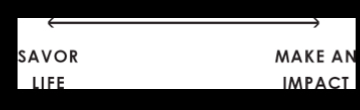
There is a point to be made about working as hard as possible to achieve goals. Working more effectively is the better approach because it expands your capacity exponentially.- a. Truth is the essential foundation for any good outcome. we should resist the temptation to deny reality or bend facts so that it fits our faulty narratives.
- b. be radically open-minded and radically transparent are invaluable for effective learning and change. Learning is a virtuous cycle of encountering events, making decisions, seeing their outcomes and improve our understanding of reality as a result. Being open-minded makes what you are doing and why so clear to yourself and others that there can’t be any misunderstandings. Being open-minded enhances the efficiency of these feedback loops. Being radically transparent might expose you to criticism, yet you won’t learn without it.
- c. Don’t let fears of what others think of you stand in the way. You want to be you while at the same time be open-minded to recieving feedback about how others perceive that.
Being transparent has many benefits:- It allows us to be ourselves
- It allows others to understand our actions better
- It provides opportunities for improvement and feedback through trust.
- 1.4 Look to nature to learn the laws of reality: humans did not create the laws of the universe. As a result, we need to understand these laws that exist. We can best do that by acquiring knowledge relevant to the field we work in but also by spending time in nature observing how the different components of it combine together to create the reality we live in. It is also beneficial to speak to people who are expert in nature and that field.
It’s good when you want to learn something to approach it from two perspectives:
1. Top-down: Say you want to learn about human body, you can start by learning about the DNA make-up of the body cells. You are studying broad facts about the thing that you want to learn about.
2. Bottom-up: You take each specific case, you dissect it and learn all aspects associated with it.
The perspective that you should take is to learn from nature: observe it, see how things work and learn from it. - Evolve or die: This holds true not only in people, but also in economies, countries and companies. If a company doesn’t change its ways of operating to adapt to changing realities or deal with competition, they’ll eventually fall behind and eventually disappear. It is a self-enforcing cycle.
- 1.5: Evolving is life’s greatest accomplishment and its greatest reward. This is wired to us. We instinctively want to get better at things and have created technology to help us with that. Humans themselves evolved from other species some 200 thousand years ago and there’s a good chance that they will evolve into a higher-level species with the advent of technology and the role it’s taking in helping to accelerate evolution.
- Realize that you are simultaneously everything and nothing: When we die, we stop perceiving existence and thus our existence matters the most to us – and also ensuring that we have the best life possible. Yet, if we contemplate our existence from outside in, we realize how insignificant our existence in. We are one from 7.5 billion people on planet earth, and our species is one from thousands of species that live in the same planet. There are so many other planets which make our galaxy, and our galaxy is but one of many other galaxies that make the universe. Our existence is short.
- What you will be will depend on how you see things in life and who you are connected to. Your perspective on life determines what you will be. YOu will also have to make the decisions as to when others’ priorities will trump yours and which group of people you will allow this to happen for.
- 1.6 Understand nature’s practical lessons: helps you make the difficult choices in life and deal with reality. Understanding that nature optimizes for the whole rather than oneself can help us better understand why almost everything that seems “bad” stems from us having a view of what we want.
- People chase after things thinking that they get them happiness. The journey to getting better at something provides long-term satisfaction that none of the things we own does. That is because once we own something, we quickly become not as satisfied with it. Things are just the bait. Chasing after them forces us to evolve.
- 1.7 Pain + Reflection = Progress. There is no avoiding pain, especially if you want to push your limits. Pain is nature’s way of telling us that we are reaching our limits. It is up to us to find ways to cope with this pain as we are evolving. This kind of mindset is not for everyone, but if you adopt it and it is for you, it will be very rewarding in your life. You will notice as you start overcoming obstacles that they are not as difficult up close as they seemed from far, that other challenges become another “one of those”. Thus, you need to develop a reflexive reaction to psychic pain that causes you to reflect on it rather than to avoid it. This will facilitate rapid learning/evolving.
- a. Go to the pain, rather than avoid it. Developing the habit of embracing pain and learning from it will get you to the other side where you are hooked on: 1. identifying, accepting, and learning how to deal with your weaknesses. 2. You prefer that people around you be honest with you rather than keep their negative thoughts about you to themselves, and 3. being yourself rather than having to pretend to be strong where are you weak.
- Embrace tough love: One of the gifts that you can give to people you love is the power to deal with reality to get what they want. In pursuit of my goal to give them strength, I will often deny them what they “want”. Although difficult emotionally, this will make them go through the process of struggling to get what they want rather than becoming weaker and dependent on getting more help.
People prefer not to have weaknesses. The world around us has taught us to hide our weaknesses and be embarrassed by them. Yet, people are happiest when they can be themselves. If you can be open with your weaknesses it will make you feel freer and will help you deal with them better. - This evolutionary process of productive adaptation and ascent becomes particularly important when facing major setbacks in life. At some point in your life you will crash in a big way: you could lose a loved one, fail at your job or with your family, have a major accident, realize that the life that you’ve always dreamed is out of reach forever. At such points, you may think that you do not have the strength to go on. You almost always do. However, your ultimate success will depend on realizing that fact, even though it might not seem that way at the moment. This is why people who have endured setbacks that seemed devastating at the time ended up as happy as they originally were after they successfully adapted to them.
- 1.8 Weighing second and third order consequences: by recognizing the importance of high-level consequences of decisions we make, we will see that people might overweigh the first-order consequence which will mean that they will often not reach their goals. That is because first-order consequences often have opposite desirabilities from second-order consequences, resulting in big mistakes in decision making. For example, first-order consequences of exercising (time and pain spent) are commonly considered undesirable, while the second-order consequence (better health and more attractive appearances) are desirable. Similarly, food that tastes good is often bad for you and vice versa.
Quite often first-order consequences are the temptations that cost us what we really want, and sometimes they are the barriers that stand in the way. It’s almost as if nature sorts us by throwing us trick choices that have both types of consequences and penalizes those who make their choices on the first-order consequence alone. - 1.9 Own Your Outcomes: in life, we will face challenges and make mistakes. Life will give us opportunities to recover from our mistakes that if we handle it well, we can have a terrific life. There are sometimes major influences on the quality of our lives that are beyond our control – the environment we were born into, accidents and illnesses, but for the most part even the worst circumstances can be made better with the right approach. Whatever circumstances in life present you, dealing with them is far better than complaining about things beyond your control.
So don’t worry about what life has dealt you, instead it is up to you to connect what you want with what you need to do get it and then find the courage to carry it through. - The biggest mistake that most people make is to fail to see themselves and others objectively. They will put themselves into situations that are disadvantageous to them – considering their own weaknesses and others’ weaknesses.
- Sometimes as a the designer/manager of your life, you may recognize that you need to fire yourself as the worker and find a good replacement, while staying in the role of designer/manager of your own life. You shouldn’t be upset if you find out that you’re bad at something – you should be happy that you found out, because knowing that and dealing with it will improve your chances of getting what you want.
Nobody can be good at all things. Would you want to have Einstein on your basketball team? when he fails to dribble and shoot, would you think of him badly? imaging all the areas that Einstein in which Einstein was incompetent, and imagine how hard he struggled to excel even in the areas in which he was the best in the world - There are 4 ways to deal with a weakness:
- You deny it
- You acknowledge it and work on it
- You can accept your weakness and find ways around it
- You can change what you are going after.
- Most people aren’t good at confronting their weaknesses and make some hard choices. Ultimately, it boils down to the following:
- Ability not to overweight first-order consequence and be mindful of second and third order
- owning up to any bad outcome
- don’t confuse what you wish to be true with what is really true.
- do not let pain stand in the way of progress and learning.
- don’t worry about looking good – worry about achieving your goals.
- 2. Use a 5-step process to get what you want out of life:
- Identify clear goals
- Identify and don’t tolerate problems that stand in the way of you achieving goals.
- accurately diagnose problems so you get to the root cause of them.
- design plans that will get you around them.
- do what’s necessary to push these designs through to results.
To evolve quickly, you have to follow this process continuously, setting your goals successively higher.
You need to approach each step separately: when you set goals, just set goals. Don’t worry about the problems that will arise and how you’ll get there. When you are identifying problems, do not worry about how you’re going to solve them just yet. Blurring the steps will lead to sub-optimal results and you need to approach this process with a clear and rational head. Ask for help if necessary.
A good way to think of it is to pretend that life is game or martial arts, the object of which is to get around a challenge and reach a goal. once you accept its rules, you’ll accept the discomfort that comes with it. Things like “This is not fair, easy” or “I can’t do that” are of no value and that it pays to push through. - 2.1 Have clear goals:
- a. prioritize goals: Life will throw at you so many goals and things that you can do. You need to be able to determine what matters to you and let go about other options. Some people fail at this step: they do not want to let go of any of the options and they end up pursing too many without accomplishing any or just accomplishing a few.
- b. differentiate between desires and goals: goals are objectives that you need to achieve in life, while desires are passing urges. If your goal is to be healthy, you shouldn’t be eating chips – a desire.
- c. Decide what you really want in life by reconciling your goals and desires. What will ultimately fulfill you are things that feel right at both levels, as both desires and goals.
- e. Never rule out a goal because you think it is unattainable. Your assessment of what is attainable at any given moment in time is dependent on what you know at the moment. Once you start your pursuit, you will learn more especially if you work with others. Of course there are impossibilities or near impossibilities such as playing center on a professional basketball team if you’re short, or running a four-minute mile at age seventy.
- f. Great expectations create great capabilities: if you set your goals to what you already know, you’ve set the bar too low.
- g. Almost nothing can stop you from achieving your goals if you have flexibility and self-accountability. Flexbility is what allows you to accept what reality teaches you; self-accountability is essential because if you own up failing to achieve a goal, you will recognize the lack of flexibility or creativity in your approach to achieving a goal.
- h. knowing how to deal with setbacks and use them as a catalyst to move forward is very important.
- 2.2 Identify and don’t tolerate problems:
- a. View problems as improvement opportunities screaming at you. A problem is triggered when you cannot deal with a situation considering your current level of knowledge of it. For this reason, it is very important to bring it to the surface – although difficult. Successful people know that it is a must to do so.
- b. Don’t avoid confronting problems because they are rooted in harsh realities that are hard to look at. Thinking about problems that are difficult to solve will make you anxious, but not thinking about them will make even more anxious. When a problem stems from your own lack of a skill or talent, most people feel shame. Get over it: acknowledging your weakness is not the same as surrendering to them. It is the first step towards overcoming them. The pains that you feel are rewarding pains that will test your character and reward you as you push through them.
- c. Be specific in identifying your problems: accurate identification of a problem is very important as different problems call for different solutions. If the problem is caused by inadequate skill in a certain area, additional training may be called for. On the other hand if the problem is caused by your innate weakness in an area, you may have shift the role that you play or seek assistance from someone else. e.g.: if you’re not good at accounting, hire an accountant. If a problem stems from someone else weakness, replace them. That is just the way it is.
- d. Don’t mistake the cause of a problem with the real problem: saying that your problem is “you cannot get enough sleep” is not clear. It is best to start by identifying the bad outcome first “performing poorly in my job”. Not sleeping might be the cause of the problem or the cause might be something else.
- e. Distinguish big problems from small ones: you only have so much time and energy; make sure you invest them in exploring the big problems.
- f. NEVER TOLERATE A PROBLEM: regardless of the cause: too difficult to deal with, you don’t care enough to solve it, or because you cannot muster enough of whatever it takes to resolve it. You need to develop a fierce intolerance of badness of any kind, regardless of its severity.
- 2.3 Diagnose problems to get at their root causes:
- a. Focus on the “What is” first before focusing on “what to do about it”: proper diagnosis is extremely important. It can take anywhere from 15mins to 1hr. Resist the temptation to the solution immediately. Instead, get an understanding from the people involved in the problem and look at the evidence together to determine the root causes.
- b. different symptoms from causes: saying that you have missed the train because you were late for it doesn’t make latency the root cause of the problem. It might be a symptom of forgetfulness.
- c. Knowing what someone is like will tell you what you can expect from them. You will have to get over your reluctance to assess what people are like if you want to surround yourself with people who have the qualities that you need.
- 2.4 Design a plan
- a. Before starting the design process, think about what led you to the situation you are in now: and visualize what you and others need to do so you will reach your goals.
- b. See the problem as a set of outcomes produced by a machine. This way you practice higher-level thinking, keep emotions at bay when looking at the problem.
- c. There are many paths to solving a problem: you only need one.
- d. Visualize in your head how the plan will be carried through: think about like a movie script that you visualize in your head. This way you will move from generalities, high-level thoughts to specifics and estimated timelines. The real-world issues of costs, time and personnel will undoubtedly surface as you do this.
- e. Publicize your plan and get feedback for it.
- f. Recognize that it doesn’t take a lot of time to design a plan: a few our in one day or a few hours spread over a week or so. It is essential to recognize that planning proceeds execution.
- 2.5 Push through to completion
- a. A plan without execution will go nowhere. Successful execution requires perseverance and self-discipline. You need to stop and ask yourself “why” if your plan execution is stalling.
- b. Good work habits are often underrated: people who push through successfully have to-do lists that are reasonably prioritized, and they make certain each item is ticked off in order.
- c. Establish clear metrics to make certain that you are following your plan, and it would be best if you can have an outsider objectively measuring and reporting on your progress.
- 2.6 Your weaknesses do not matter if you find solutions to them: going through the whole spectrum of identifying goals to executing plans require a broad set of skills that no single person has. Goal identification requires high-level thinking and visualization. Identifying problems and not tolerating them requires honesty with oneself, ability to prioritize and also to synthesize information. Identifying the root cause requires you to be logical, ability to read people effectively. Designing a plan requires visualization and practicality. Executing requires discipline, good work habits, and result orientation.
Everyone has weakness so it is unlikely that any one person possesses all the qualities needed to work on the whole process individually. Recognize your weaknesses by attempting to see the pattern of mistakes that you make.- a. Look at your pattern of mistakes and identify at which step of the process you typically fail. Ask for input from others too.
- b. Identify the at least one big thing that stands in the way of your success. Write down what your big obstacle is – identifying problems, designing solutions, pushing through to results, and explain why it exists – emotions, lack of visualization of adequate possibilities). While you and most people probably have more than one major impediment, if you can remove or get around that one, you’ll benefit hugely.
there are two avenues to success: either you have what it takes to be successful, or you can get it from others. Getting it from others requires humility.
- 2.7 Understand your own and others’ mental maps and humility: some people are good at knowing what do on their own; they have good mental maps – they have more answers inside themselves than others do. Similarly, other people are more humble than others. Most powerful is having the combo of both. Picture an x axis that plots one’s level of humility and open-mindedness, and a Y axis that plots one’s skill level in developing mental maps. You’d want to be at the top right.
- 3. Be radically open-minded: This is one of the most important qualities a person could develop. Two major obstacles – that almost all of us have, get in the way of us being radically open-minded: our ego and our blind spots.
- Our ego refers to the subliminal part of our consciousness that controls our insecurities, our fears, our desire to be viewed favorably by people. It makes us less open to constructive feedback. It is controlled by the Amygdala. Yet, the cortex part of our brain knows that this feedback is good for us to have. It is the part of the brain that is responsible for the executive function of the brain – conscious decision making. At any given point in time, there could be a tension or fight between the two yous to make a decision. One you wants you to have that piece of cake, while the other urges you to resist the temptation. Once you understand how your logical/conscious you, and your emotional/subconscious you fight with each other, you can imagine what it is like when your two yous deal with other people and their own two “thems”.
- “To be effective you must not let your need to be right more important than your need to find out what’s true. If you are too proud of what you know or how good you are at something you will learn less, make inferior decisions, and fall short of your potentials.”
- c. Understand your blind spot barrier. Aside from being a victim of your ego – your pride to admit that you’re incorrect about something prevents you from seeking the true, each person has a different way of thinking. Some people are naturally linear thinkers, others think laterally. Some see the big picture while they miss the details, others are the opposite.
Each one of us has a blind spot in their thinking. Unfortunately highlighting it is as acceptable as highlighting a physical weakness. Further, such blind spots are very hard to spot. A person who cannot identify patterns and synthesize doesn’t know what it’s like to see patterns and synthesize any more than a color-blind person know what it is like to see colors.
When two people reach opposite conclusions, someone must be wrong. Shouldn’t you make sure that someone isn’t you?
The failure to benefit from someone’s thinking doesn’t just occur during disagreements, it also occurs when we’re trying to solve for a problem. Most people spin in their own heads instead of taking in all the wonder thinking available to them. They keep on doing that until they crash. As they crash repeatedly, they could learn to adapt by a) Teaching their brains to think differently than what naturally occurs to them, b) using compensating mechanism (such as reminders) and/or c) getting others who are strong where they are weak.
Different ways of thinking are symbiotic and complementary instead of disruptive. Aristotle once defined tragedy as a terrible outcome arising from a person’s fatal flaw – a flaw that, had it been fixed, would have led to a wonderful outcome. In my opinion, these two barriers – ego and blind spots, are the fatal flaws that keep intelligent, hardworking people from living up to their potential. - 3.2 Be radically open-minded
Once you believe that the way you see the world is not optimal- you have blind spots, and you recognize that it is in your best interest to consider other views – others might see something better than you, the threats and opportunities they are trying to point out really exist, and if you move from thinking that you always have to be right to the joy of finding the truth no matter where it comes from, you’ll be more likely to make good decisions.
Most people don’t understand what it means to be radically open-minded. They describe open-mindedness as being “open to being wrong” but stubbornly cling to whatever opinion is in their head and fail to seek an understanding of the reasoning behind their alternative points of view.- a. Have a genuine humility that you may not know the best possible path, and recognize that your ability to deal well with “not knowing” is more important than whatever it is that you do know. Most people make bad decisions because they feel certain that they are right and don’t allow themselves to see other alternatives that exist. Radically open-minded people recognize that coming up with the right questions and asking other smart people what they think is far more important than having all the answers. They recognize that they need to immerse themselves in the “unknown” before coming up with the right answers.
- b. Recognize that decision making is a two-step process: first take in all the relevant information, then decide. Most people decline to take information that may contradict with what they already have concluded. When asked why, the common answer is “I want to make up my own mind”. These people seem to think that taking other perspectives will somehow threaten their ability to decide what they want to do. Nothing could be further away from the truth. Taking in others’ perspectives doesn’t reduce your ability to think independently and make your own decisions. It will broaden your perspective as you make them.
- c. Know how to engage in thoughtful disagreements: be genuniely interested in making sure that it is not you who is wrong when you disagree with someone. Express this genuine interest by asking questions, be calm and dispassionate. Observe a two minute rule where each one of you won’t interrupt the other so that each gets a chance to express their own opinion. Spend time doing this with people are most believable.
Disagreements like these do not occur often because people mistaken them for conflicts. Often, if two people want to go to a restuarant and one suggests an option, the other person might say that “they like it too” or just be silent just to avoid what they think is conflict. - 3.4 Triangulate your view with believable people who are willing to disagree: You can increase your chances of making the right decision by having believable and highly-qualified people debate their differing opinions when it comes to a decision that you want to make.
To give an example, Ray got diagnosed by a highly-qualified specialist with a condition that could likely lead to esophagus cancer – a deadly form of it. The specialist recommended a wait and see approach as the standard procedure to deal with such condition is to remove the esophagus – Ray did not qualify for it due to the specifity of his condition.
Ray sought a second opinion by another highly-qualified expert in the subject matter. She advised that Ray could get his esophagus removed safely and that the chances of death during the operation was 10% while complications from the surgery was 70%. Ray got both of them to talk on the phone. They still disagreed but respectfully.
Ray finally sought a third opinion by a doctor who said that he could just have his esophagus examined every 3months to manage the tumor and ensure that it doesn’t go to the blood. Results of the test finally came and it was not cancerous. By engaging with thoughtful disagreements and having experts exchange opinions, Ray enhanced the quality of his outcome. - Differentating between close-minded and open-minded people:
- Close-minded people feel frustrated that they’re not understood rather than seeking to understand others. They focus on being understood rather than understanding others
- close-minded people say ” i could be wrong but here’s my opinion” instead of asking a question when they suspect that they’re wrong.
- close-minded people do not give others a fair chance to speak – and don’t listen actively.
- They lack a deep sense of humility and have trouble holding two thoughts simultaneously.
- Practice open-mindedness:
- a. Watch for physical signs in your body that occur each time you’re likely to react irrationally: make these signs be a signal for you that you need to slow down and watch for how you make decisions.
- b. Make it a habit to be open-minded: while it is difficult to remember to recognize that you’re likely to make an error in judgment when you’re consumed by emotions or a difficult situation, over time practicing control in these situations yields positive results.
- c. When you are the only one disagreeing with highly-believable poeple, recognize that there is a very good chance you’re biased.
- d. Get to know your blind spots – errors and lapses in judgements that you do on a regular basis in a similar set of circumstances.
- e. Meditate: it helps the creative thought process and allow you to slow down.
- f. Be evidence-based and encourage others to be.
- g. Use evidence-based decision making tools: machines help make our decision process be less biased.
- h. Know when to stop fighting and have faith in your decision-making process.
- 4. Understand that people are wired very differently. We need to recognize that each person has a different perspective on the world. Each person differs in their capabilities – common sense, imagination, memory, attention to detail and so forth. This is why getting different people with different capabilities and skillset to work together. Managing an organization becomes like managing an orchestra: if done right, it can be magnificent.
Ray pioneered the concept of baseball cards at Bridgewater. In it, he’d list adjectives that describe people: ambitious, creative, reliable, determined; the actions that people took or didn’t take “holding others accountable”, “pushing through to results”, and terms from personality tests such as extroverted and judging. Once the cards are established, he created a process to have people evaluate each other. People were worried that the process could bias others’ view of themselves, could be inaccurate, too complex.
We develop meaning and special reward from expanding the size of the pie when we work as part of the group, not so much because it expands our own piece but the process of expanding the pie cooperatively is rewarding.
- 4.3 Understand the brain battles and how to control them to get what “you” want.
We have evolved from animals, who think in reaction to events that happen outside, who cannot think in abstract terms, who focus on satisfying their instincts than thinking about expanding the pie.- a. Realize that the battle is between the two yous: the emotional you that is reactionary and the logical you which is deliberate and methodical.
Knowing why the two systems exist help us understand them better. - b. Realize that moments of realization are likely to occur when you’re not involved in deliberate thinking to create these moments of deep realization. While it is counterintuitive to think that less is more, and that you need not force your mind to think through a problem and cram knownedge as a way to uncover insights, in reality moments of realization about an issue might happen when we are most relaxed – in the shower, while getting ready to go to bed. Thi sis why practicing meditation helps create those moments of clarity that result in great insights.
- The power of habits: Habits make us operate in autopilot mode. You no longer think about the action, you just do it. That is because habits are controlled by a unique part of the brain. Research shows that it takes about 18months to form a habit. Once formed, the habit is likely to last a lifetime. A habit is an interia, things that we do automatically/don’t do without thinking. A habit is three parts: a cue, an action, and the reward that you get out of it.
- 4.4 Understanding yourself and the people around you: Bridge Waterhouse uses a variety of methods – Myers Briggs, Work Personality Inventory, Team Dimensions profile to assess employees. People’s preferences for thinking and action could be identified through the following dimensions.
- Introverts vs Extroverts: INtroverts focus on the inner world and draw energy from ideas, memories and experiences while extroverts draw energy from the outside world and from being with people. Introverts prefer to work on a problem on their own, and share the solution when they have an outcome. Extroverts will find it difficult not to have anyone to talk out ideas with. This can be particularly painful for introverts. Introverts prefer communicating via writing as opposed to speaking in group settings and tend to be less open with their critical thoughts.
- Intuiting vs Sensing. This refers to seeing the big picture vs the details: Seeing the forest vs the trees. Naturally you’d want someone with an eye for details to look over a legal document. A sensing person would get thrown off by typos such as “they’re” instead of “their” while the intuiting person wouldn’t even notice it because they are focused on the context.
- Perceiver vs Planner: some people like to start from the inside out: they want to have a plan on how they should do something and carry out the plan. The perceiver would take things as they come and work with them accordingly. These two types of personalities could frustrate each other: The perceiver thinks that the planner is too rigid. The planner thinks that the perceiver change directions too often without weighing precedent in their decision-making process. Planners assume that if something was done in a certain way before, it should be done the same way again.
- Thinking vs Feelings: Thinkers focus on facts and logic while feelers focus on relationships and harmony between people. Each has strengths: Feelers are better suited for roles that require lots of empathy, interpersonal contact, and relationship building while thinkers is how you’d hope your doctor approaches a diagnosis.
- Goal Orientation vs Task Orientation: There is high correlation between those who see the big picture and those who can step outside of the daily tasks to identify the big picture. These can be visionary leaders who come up with new ideas out of thin air. A Tasks person is focused more on accomplishing what is at hand, can be discomforted by a sudden change, and is keen on maintaining the status quo and how things are typically accomplished. Each type of person is important in their own ways to an organization. A task-oriented person is very valuable when it comes to completing tasks that require attention to detail.
- Creator vs Advancer vs Refiner vs Executor vs Flexor
Creator thrives in unstructured environments and thinks outside of the box to come up with new ideas. Advancers uses relationships to help move a project closer to completion. Refiners: challenge the status and question assumptions to help come with better outcomes. Executor are good for accomplishing tasks assigned. Flexors can adapt between the different 4 styles depending on what is necessary. - Understanding the role of Shapers: Shaper = Visionary + Practical Thinker + Determined. Capable of holding conflicting thoughts simultaneously.
- Manage yourself and orchestrate others to get what you want. I have found that the biggest challenge is to have the higher-level you manager your emotional lower-level you. The best way to do that is to consciously develop habits that will make doing the things that are good for you habitual. They act like conductors in an orchestra who do not necessarily know how to play each instrument but know enough about each instrument to have them work together nicely. They also take on the thankless task of identifying those who do not fit well in the orchestra and making sure that they are replaced so that their individual contribution is not holding the orchestra back.
- 5. Learn How to Make Decisions Effectively. The decision-making process happens more in subconsciousness and is more complex than we think. Consider an example of how you maintain a safe distance between you and a car. If you were asked to describe that in detail to someone who’s never driven a car, chances are you will fail.
There are two parts to making decisions.- Realize that you should not rely on emotions and that you should learn before you decide.
- Learning: We have seen through the book that our brain holds different pieces of knowledge in different parts of it – habits, long term memory, short term. what you know paints a true and rich picture of the realities that will affect your decision. This is why it is important to hear at least one opposing view before making a decision.
- Deciding: Deciding is the process of drawing on relevant data points that you have in mind and then weighing them to determine a course of action. This involves playing different scenarios through time to visualize how to get an outcome consistent with what you want. You also want to consider first-order, second-order and third-order consequences when making a decision. Never jump on the first available option, no matter how good it seems – you might be failing to consider second and third order consequences. Instead, always ask yourself if you’re learning? this can help you avoid the pitfall of making a decision first then seeking data to support it. Learning well stems from the ability to synthesize accurately and knowing how to navigate levels.
Bringing the different data points that are relevant into a decision requires the ability to synthesize data points well. The ability to synthesize data points could be developed in part by comparing how you do it vs other believable people who are good at it. To synthesize well, you must 1) synthesize the situation at hand, 2) synthesize the situation through time, and 3) navigate levels effectively.- It is important that you ask questions to people who are infomred and believable.
- differentiate between great and new: when people want to decide about what movie to watch or what book to read, we tend to be drawn to new vs the classic. Remember that great is better than new.
- Know that when you look at one single data point, you need to keep it in perspective because while looking at that single data point, we tend to amplify it to be bigger than what it actually is – nothing in life is as important as you think it is while you’re thinking about it.
- don’t believe everything you hear: opinions are a dime a dozen. Everyone will offer them. Learn to differentiate between opinions and facts.
- Don’t oversequeeze the dots: a dot is just one piece of data from one moment in time. keep that in mind as you synthesize.
- Synthesize the situation through time. To see how the dots connect through time, you must analyze and sort different types of information which isn’t easy.
Example: imagine a day in an ice cream shop where 8 different outcomes occur – some good, some bad. Now imagine that you represent each type of event with a unique letter – W for Sales, X for Customer Experience, and that the higher the location of a point in the chart, the better quality it is and vice versa.
You could have a chart that looks similar to the below:

one could conjecture from the above that the sales are good but customer experience is bad becuse of long line-ups – maybe a bus with lots of people made a stop at the shop. - The picture gets a lot more complex over time. Look at the data from 30 days.
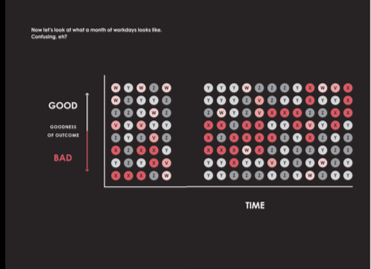
The chart looks quite confusing.
but if you isolate X – customer experience, you can see that it is improving over time.
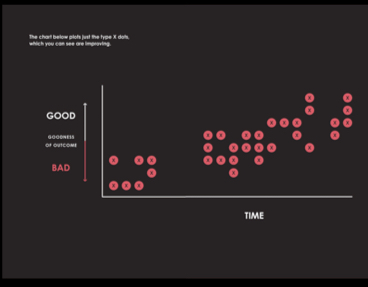
The ability to discern such patterns is rare, and while it is partially innate, it can be improved with practice and by abiding to the following principles.
a. Keep in mind BOTH the rate of change and the level of things and the relationship between the two. Example: if someone’s score improves from being in the 30s-40s to being in the 50s-60s but takes 9 months to do so, it would be appropriate to say that it is improving over time but then still woefully inadequate. everything important in your life needs to be on a trajectory to be excellent at an appropriate pace.
b. Be imprecise: the art of being sufficiently good at approximation is insufficiently valued, and this impedes conceptual thinking. Understanding the content of “by and large” is important. Example: look at the ice cream shop and imagine the value of quicking seeing the approximate relationships between the dots vs taking the time to all the edges precisely.
By and large is the level at which you need to understand most things to make decisions effectively.
c. Remember the 80/20 rule. It takes 20% of your effort to get 80% of the value of something. Understanding this saves you from being bogged down in unnecessary detail once you’ve gotten most of the learning you need to make a decision.
d. Be an imperfectionist: there are generally 5-10 factors to consider when making a decision. Don’t spend too much time on little differences at the expense of important things. Even with the 5-10 factors, spending time on them beyond a certain point yields limited benefit.
- 5.4 Navigate levels effectively: reality exists at different levels. Example: You are looking at a map of your town. If you zoom out enough, you can see some important information that yo won’t see if you were to to zoom in to a level where you can see street names. If you’re too zoomed-in, you won’t be able to tell whether the shoreline is along a rive, a lake or an ocean. You need to know which level is appropriate to your decision.
We’re constantly doing this zoom-in, zoom-out process whether we’re aware of it or not and whether we’re doing a good job doing it. Below is an example of what that looks like in real life.
1. high-level picture: I want to have work that adds meaning to my life.
1.1 Subordinate concept: I find meaning in helping people realize what’s keeping them from staying healthy.
sub-point – I want to be a doctor.
sub-sub-point: I need to go to medical school
sub-sub-sub point: i need to get good grades in sciences.
sub-sub-sub-sub point: i need to stay home and study tonight.
We tend to navigate between different levels when we talk.
a. Use the terms “above the line” and “belove the line” to establish which level the conversation is on. Above the line is for main points and below is for sub points. Usually, lines of reasoning get jumbled up and confusing when the speaker is caught up in below the line details without connecting them back to the major points. An above the line should focus on only above the line concepts only going below when it’s necessary to illustrate something.
b. Remember that decisions need to be made at the appropriate level, but they should be consistent across levels. so you can’t say you want to be healthy and eat 12 sausages every day for breakfast.
In conclusion, remember that
1. multiple levels exist for each subject.
2. know what level you’re examining the subject on.
3. Consciously navigate through levels rather than see objects as undifferentiated piles of facts that can be browsed through randomly.
4. Diagram the flow of your though processes using the outline template shown below?
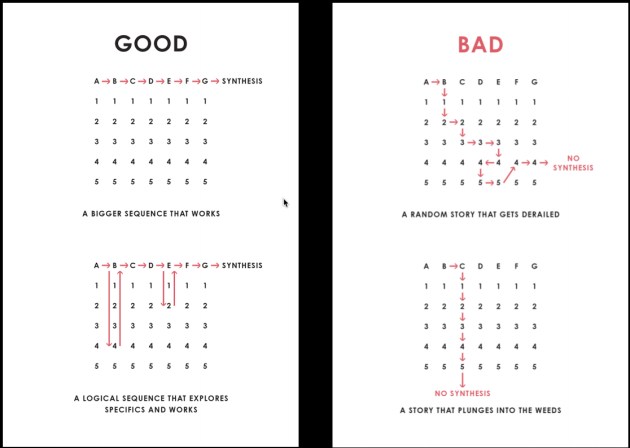
- a. Realize that the battle is between the two yous: the emotional you that is reactionary and the logical you which is deliberate and methodical.
- 5.5 Make your decisions based on evidence, rather than letting the lower you subconsciously guide you, which might make you erroneously blame fate. This is especially important in organizations. Successful organizations are ones where decisions are made based on evidence rather than power.
- 5.6 Approach every decision as a value-expected calculation.
Example: say that the probability of you winning a 100 is 60% while the probability of you losing is 40%. This means that the expected value is 20 (100*.6 – 100*.4).- a. Always try to improve your odds – regardless of how positive they are. You can do so by obtaining new information about the topic you’re making a decision on, and that is why it’s always a good idea to stress-test your thinking, even when you’re pretty sure you’re right.
- Watch for people who can argue against something whenever they can find something – anything wrong with it without properly weighing all the pluses and minuses.
- 5.7 Assess the benefit of getting additional information against the cost of not deciding.
- prioritize must dos over nice to do.
- chances are you won’t have time to deal with unimportant things, which is better than having time to deal with important things.
- differentiate possibilities from probabilities. They’re the opposite of philosophers who get lost in the cloud of possibilities. They are practical thinkers.
- Shortcuts to becoming a great decision maker
- 5.8 Simplify: Any fool can complicate things, it takes a genius to simplify. Think of Picasso, he always painted great representational paintings since ever he was a child but he pared down and simplified as his career progressed. Not everyone has a mind that works that way but just because you cannot do something naturally doesn’t mean that you cannot do it.
- 5.9 Use Principles: Recognize the patterns that come when facing seemingly different situations in life. Every situation can be reduced to “another one of those” which is a situation that you have experienced before. To get effective at this, you will need to do the following:
- Slowly analyze the criteria that you went into you making a decision.
- Write down the criteria that went into making that decision.
- Think about those criteria when you have an outcome to assess, and refine them before the “next one of those” comes along.
Your ability to match the situation at hand with a similar one that happened in the past will get better with practice. Situations can also be a hybrid when it contains a few “another one of those” - 5.10 Believability weight your decision making. Working with highly-believable people will never hurt your decision-making ability. To be successful at that, it is important that you do not overweigh the believability of your decision more than is logical 2) not distinguishing between who is more or less credible.
When you disagree with someone, see if you can agree on the principles that should be used to make decisions. If you agree on them, apply them to the case at hand and you’ll arrive at a conclusion everyone agrees to. If you disagree on the principles, try to work through your disagreements based on your respective believabilities.
- Systemized and Computerized Decision Making: Picture a network that connects your AI assistant with other assistants worldwide and allows you to tap to a world-wide network of experts to address about any question you may have: what career you should pursue based on what you’re like, how you should deal with a person based on what they are like. The digital information that exists about us allow companies to have an in-depth level of understanding of who we are more than ever before. While that might be scary to some, it allowed Bridgewater to make informed decisions.
While some think that technology could replace humans, Ray thinks that technology and human intelligence will continue to work together to produce superior outcomes. There are still many functions performed by our brains that AI cannot yet. People who have been rewarded the most are those with determination, common sense, and imagination.
Computers still have the capacity to process data at a rate that the human mind cannot: consider millions of data points, work tirelessly 24/7, and examine an issue from different perspectives. This is why computers will need to work hand-in-hand with humans.
You can turn your decision-making process into one that takes data, applies and weights the relevant criteria and recommends a decision. As an example, say that you want the heat to be turned on in your room as soon as the temperature hits below 68 and between 12-5am. This way, you can have a decision-making formula that will express this realtionship: turn the heat on if temperature is less than 68 and time is not between 12-5am.
As of now, only human intelligence can apply the interpretations that are required to provide computer models with appropriate input. For example, a computer can’t tell you how to weigh the value of time you spend with your loved one, or how it compares with the time you spend at work or the optimal mix of the two - 5.12 Be Cautious about trusting AI without having deep understanding.
The terms “Artificial Intelligence” and “Machine Learning” are used interchangeably in everyday language although they mean very different things. Ray divides this field to Expert Systems, Mimicking, and data mining.
Expert Systems are those that take input with weightings from humans, and draw different future possibilities based on them.
Mimicking comes with the ability for systems to also observe patterns and apply them in decision making without having an understanding of the logic behind them. These systems could be powerful in situations where things happen over and over again and are not subject to change, such as in a game bounded by hard and fast rules.
to process vast amount of information and draw relationships between the data.
The main thrust of machine learning in recent years has gone in the direction of data mining, in which powerful computers ingest massive amounts of data and look for patterns.
While this approach is useful, it is risky when the future is different from the past.
Take investment systems. When a rule is widely believed, it becomes so widely used that it affects the price. In other words, the value of a widely known insight disappears over time. Without deep understanding, you won’t know if what happened in the past is genuinely of value.
Ray prefers to have an in-depth understanding of situations at hand rather than simply defer the decision to some AI system that he doesn’t understand. He’s not sure whether he’s doing this for the right reason or just doing it out of habit and becuase it’s easy for him to do having followed this process for years as opposed to thinking about incorporating AI into his decision-making process.
When you get down to it, our brains are essentially computers that are programmed in certain ways: take in data and spit out instructions.
- Putting It All Together:
Ray helped me uncover that in order to get what I want out of life, I need to recognize patterns of things that occur in life over and over again, and employ a few well-thought-out Pricniplies based on truths that do not change in life in order for me to deal effectively with them. Those principles need to be continuously applied and refined over time.
It is of utmost important to embrace reality and deal with it, rather than wish that your circumstances were different or wishing that reality just worked differently in general. Embrace your reality and deal with it. After all, making the most of your circumstances is what life is all about.
When you want something, go after it, fail and learn accordingly. Dealing with failures will make or break you. Evolution of the universe happens to us too: our life could be thought of as a series of learning circules – experiences, that either evolves upward, downward or remains at the same level.
We have talked about the 5-step process to effective decision-making, starting with identifying goals, listing and NOT TOLERATING problems, diagnosing problems, dealing with these problems – designs that help you get around them, and finally achieving the subtasks.
If you’re willing to confront reality, accept the pains that comes with that and follow the 5-step-process, you are on your path to living a successful life.
Understanding that everyone’s outlook and understanding of life necessitates radical open-mindedness. Radical open-mindedness is also a function of our realization that we are biased in two ways in the way we see the world: we have blind spots and we have ego that makes us value our opinion more than we should and our desire to have other people recognize us as capable. Calibrating these biases means that we need to be very open-minded and accepting of the opinion of others, especially those who are subject matter experts in a field. We need to realize that going it alone will not help us go as far as we need to when it comes to achieving our goals. This is another reason why radical open-mindedness is important.
In a nutshell, learning how to make decisions is the best possible way and learning to have the courage to make them comes from: a) going after what you want, b) failing and reflecting well through radical open-mindedness and c) changing/evolving to become less fearful.
There is also the need to utilize systems that help make our decision-making process more efficient and accurate. While we have looked at all of this through the lens of our own lives, the second part of the book identifies how to apply these principles in a group situation – work.
- 1.1: be a hyper-realist: understanding, accepting and working with reality is both practical and beautiful. This doesn’t contradict having dreams – dreams is what gives life flavor. Instead, it allows us to differentiate between idle dreamers who do not act on their dreams. Those who have accomplished a lot have a deep understanding of the cause-effect relationships that govern reality and have effective principles to deal with them. To Ray, dreams + reality+ determination all form a recipe for success. There is no one size fits all when it comes to a successful: a person’s version of success could be to live in harmony with life and savor it while another be to leave a dent in the universe. People fall somewhere in the spectrum below:
- Principles for Organizations:
- In order for an organization to be successful, there needs to be congruency between the organization’s goals and the employees’ goals. This congruency is essential when it comes to the mission they’re on and how they will be with each other.
- If people in an organization feel that alignment, they will work harmoniously together. If they do not, they will pull in different and conflicting directions, negatively impacting the overall performance of the organization.
- It is very important for organizations to spell out its principles and values clearly and explicitly and to operate by them consistently. These principles are a set of concrete directives anyone can understand.
- An organization is a machine made of culture and people. These two components impact each other: people influence the culture of an organization and the culture of the organization attracts a certain type of employees.
- A good employee is one who does their job well – they have the skillset necessary to succeed, and they need to be radically transparent, radically truthful and radically committed to the goals of the organization. Those who have both dimensions are rare and need to be cherished and those who have one or none of the two needs to be let go.
- Great cultures bring problems to the surface and enable employees to engage in new and stimulating work. This is essential for an organization to evolve. Bridgewater achieves that through meritocracy which allows for people to be engaged in meaningful work through meaningful relationships. Meaningful work is one that employees get excited to be involved in. Meaningful relationships, there is genuine caring for employees toward each other.
- An organization can evolve by going through the following 5 steps: 1. having clear goals. 2. Identifying potential obstacles to achieving the goal. 3. Diagnosing what part of the machine – people or culture are not working well. 4. designing changes. 5. execution.
- A great manager is one who can look at inputs – people and culture, look at outputs – goals accomplished, and addresses any deviation.
- Having a culture that quickly identifies inconsistencies between goals and outputs and designing modifications is essential to succeeding an ever-changing world.
- The evolutionary process of identifying mismatches between goals and outcomes and addressing that through the 5-step iterative process of: a. having clear goals. 2.identifying potential problems to achieving them. 3. diagnosing what parts of the machine works well. 4. designing a plan 5. execution.
This process is difficult, is what made Bridgewater successful and only a few can follow it. - Nothing is more important than getting the culture and people right, regardless of the type of business a company is engaged in.
When Ray started his company, he started it with a friend of his. Together they played Rugby. They had an assistant who was also another friend. Ray didn’t seek to manage at the time. He had the curiosity to create new things. Ray built his success on having meaningful work and meaningful realtionships. Meaningful is creative work that allowed him to break new grounds. Meaningful relationships happen when people have congruency in values and interests, having similar approaches to pursuing them, and being reasonable and have considerations for each other. At the same time, partners must be willing to hold each other to high standards and work through their disagreements, realizing that the goal is not to have no disagreements but rather to deal with them in a manner that allows parties to surface them and get through them well. - The core values and principles that Bridgewater adopted remained implicit until the company hit 67 employees. The company never changed its values and principles as it grew from 5 to 50 to 500 to thousands of employees. Everything else changed.
- Tough love is effective in building relationships and in achieving goals. You cannot comprise on the uncompromisable. We often compromise to avoid placing ourselves or others in uncomfortable positions. Yet, prioritizing comfort will produce sub-optimal outcomes for everyone.
Ray treated employees as part of his extended family – Personally buying them gifts for the holiday season and writing them a card, inviting them over on weekends to his house and be really happy when they answer that invite, celebrating their marriages and childbirths. This extra level of care allowed them to be tough on each other, and the tougher they were the better they performed and the more rewards that they have shared.
Our toughest experiences in life are remembered for the people whom we went through these experiences with. People value being part of a community on a shared mission more so than money.
In his memo to employees in 1996, Ray explained the following: - We are a company that is successful because we do things with excellence, we constantly improve on an on-going basis.
- We operate on the principles of radical transparency and truthfulness: disagreements are brought to the forefront and dealt with effectively, in a manner that allows the most truthful evidence/idea to proceed. This comes from having disagreeing parties expose how they went about making their conclusions, and by listing the help of truthful experts in the field if need be.
- In Bridgewater, there is no hierarchy. The soundness of one’s idea is what dictates the hierarchy. Best ideas should rule no matter where they come from.
- Long-term relationships are both a) intrinsically gratifying and efficient and should be intentionally built. Turnover requires re-training and therefore creates setbacks.
- Money is not the goal. The goal is to achieve excellence and money will be a byproduct of it. This is not to say that people who work at Bridgewater should expect little financial returns. To the contrary, excellence and success will bread handsome financial returns.
- A believability-weighted idea meritocracy is the best system for making effective decisions.
Ray created an environment that allowed people to make sense of things for themselves and to fight openly for what they think is best – and where the best thinking won.
The idea-meritocratic system evolved over the decades. At first, it was passionate arguments among team members that helped ultimately create effective decision than if the decisions were to be made alone. But as the company grew, Ray recognized that they need a system that allowed them to weigh the believability of different people to come to the best decisions and do that in a way that was so obviously fair everyone would recognize it. Short of that, Ray knew he would be end-up with kiss-asses and subversives who kept their disagreements and hidden resentments to themselves. - Radical Truth and Radical Transparency:
- Radical truthfulness means that employees can express their thoughts openly without fearing reprisal
- Radical transparency means that almost everyone at the organization had access to almost all information. This eliminated bad politics and the tendency to make bad decisions behind closed doors.
- A Pervasive Idea Meritocracy = Radical Truth + Radical Transparency + Believability-Weighted Decision Making.
This setup allowed each one at Bridgewater to recognize the shortcomings in their own way of thinking. Each person has a different perspective on how they view things in the world. Placing evidence as the criteria by which you judge the validity of views allow a person to move from the view that their opinions are the best to accepting others’ point of views. - Many people accept idea meritocracy intellectually but reject it initially. A small portion embraced it from the get-go while a larger minority resisted it all the way. The majority of people got better at it with time, and even wouldn’t want to operate any other way.
- Operating in an Idea Meritocracy is difficult for many people. However, it helped Bridge Waterhouse in two ways: people felt no longer the need to pretend that they are someone they are not – radical transparency, and they didn’t have to spend time speculating what other employees thought of them – radical truthfulness.
Doing so created meaningful work and meaningful relationships. - SUMMARY AND TABLE OF LIFE PRINCIPLES •
Think for yourself to decide 1) what you want, 2) what is true, and 3) what you should do to achieve #1 in light of #2, and do that with humility and open-mindedness so that you consider the best thinking available to you.
LIFE PRINCIPLES INTRODUCTION
- Look to the patterns of those things that affect you in order to understand the cause-effect relationships that drive them and to learn principles for dealing with them effectively.
PART II: LIFE PRINCIPLES
1 Embrace Reality and Deal with It
1.1 Be a hyperrealist. a. Dreams + Reality + Determination = A Successful Life. 1.2 Truth—or, more precisely, an accurate understanding of reality—is the essential foundation for any good outcome.
1.3 Be radically open-minded and radically transparent.
- Radical open-mindedness and radical transparency are invaluable for rapid learning and effective change.
- Don’t let fears of what others think of you stand in your way.
- Embracing radical truth and radical transparency will bring more meaningful work and more meaningful relationships.
1.4 Look to nature to learn how reality works.
- Don’t get hung up on your views of how things “should” be because you will miss out on learning how they really are.
- To be “good,” something must operate consistently with the laws of reality and contribute to the evolution of the whole; that is what is most rewarded.
- Evolution is the single greatest force in the universe; it is the only thing that is permanent and it drives everything.
- Evolve or die.
1.5 Evolving is life’s greatest accomplishment and its greatest reward.
- The individual’s incentives must be aligned with the group’s goals.
- Reality is optimizing for the whole—not for you.
- Adaptation through rapid trial and error is invaluable.
- Realize that you are simultaneously everything and nothing—and decide what you want to be.
- What you will be will depend on the perspective you have.
1.6 Understand nature’s practical lessons.
- Maximize your evolution.
- Remember “no pain, no gain.”
- It is a fundamental law of nature that in order to gain strength one has to push one’s limits, which is painful.
1.7 Pain + Reflection = Progress.
- Go to the pain rather than avoid it.
- Embrace tough love.
1.8 Weigh second- and third-order consequences.
1.9 Own your outcomes.
1.10 Look at the machine from the higher level.
- Think of yourself as a machine operating within a machine and know that you have the ability to alter your machines to produce better outcomes.
- By comparing your outcomes with your goals, you can determine how to modify your machine.
- Distinguish between you as the designer of your machine and you as a worker with your machine.
- The biggest mistake most people make is to not see themselves and others objectively, which leads them to bump into their own and others’ weaknesses again and again.
- Successful people are those who can go above themselves to see things objectively and manage those things to shape change.
- Asking others who are strong in areas where you are weak to help you is a great skill that you should develop no matter what, as it will help you develop guardrails that will prevent you from doing what you shouldn’t be doing. g. Because it is difficult to see oneself objectively, you need to rely on the input of others and the whole body of evidence.
- If you are open-minded enough and determined, you can get virtually anything you want.
2 Use the 5-Step Process to Get What You Want Out of Life
2.1 Have clear goals.
- Prioritize: While you can have virtually anything you want, you can’t have everything you want.
- Don’t confuse goals with desires.
- Decide what you really want in life by reconciling your goals and your desires. d. Don’t mistake the trappings of success for success itself.
- Never rule out a goal because you think it’s unattainable.
- Remember that great expectations create great capabilities.
- Almost nothing can stop you from succeeding if you have a) flexibility and b) self-accountability.
- Knowing how to deal well with your setbacks is as important as knowing how to move forward.
2.2 Identify and don’t tolerate problems.
- View painful problems as potential improvements that are screaming at you.
- Don’t avoid confronting problems because they are rooted in harsh realities that are unpleasant to look at.
- Be specific in identifying your problems.
- Don’t mistake a cause of a problem with the real problem.
- Distinguish big problems from small ones.
- Once you identify a problem, don’t tolerate it.
2.3 Diagnose problems to get at their root causes.
- Focus on the “what is” before deciding “what to do about it.”
- Distinguish proximate causes from root causes.
- Recognize that knowing what someone (including you) is like will tell you what you can expect from them.
2.4 Design a plan.
- Go back before you go forward.
- Think about your problem as a set of outcomes produced by a machine.
- Remember that there are typically many paths to achieving your goals.
- Think of your plan as being like a movie script in that you visualize who will do what through time.
- Write down your plan for everyone to see and to measure your progress against.
- Recognize that it doesn’t take a lot of time to design a good plan.
2.5 Push through to completion.
- Great planners who don’t execute their plans go nowhere.
- Good work habits are vastly underrated.
- Establish clear metrics to make certain that you are following your plan.
- Remember that weaknesses don’t matter if you find solutions.
- Look at the patterns of your mistakes and identify at which step in the 5-Step Process you typically fail.
- Everyone has at least one big thing that stands in the way of their success; find yours and deal with it.
2.7 Understand your own and others’ mental maps and humility.
3 Be Radically Open-Minded
3.1 Recognize your two barriers.
- Understand your ego barrier.
- Your two “yous” fight to control you.
- Understand your blind spot barrier.
3.2 Practice radical open-mindedness.
- Sincerely believe that you might not know the best possible path and recognize that your ability to deal well with “not knowing” is more important than whatever it is you do know.
- Recognize that decision making is a two-step process: First, take in all the relevant information, then decide.
- Don’t worry about looking good; worry about achieving your goal.
- Realize that you can’t put out without taking in.
- Recognize that to gain the perspective that comes from seeing things through another’s eyes, you must suspend judgment for a time—only by empathizing can you properly evaluate another point of view.
- Remember that you’re looking for the best answer, not simply the best answer that you can come up with yourself.
3.4 Triangulate your view with believable people who are willing to disagree.
- Plan for the worst-case scenario to make it as good as possible.
3.5 Recognize the signs of closed-mindedness and open-mindedness that you should watch out for.
3.6 Understand how you can become radically open-minded.
- Regularly use pain as your guide toward quality reflection.
- Make being open-minded a habit.
- Get to know your blind spots.
- If a number of different believable people say you are doing something wrong and you are the only one who doesn’t see it that way, assume that you are probably biased.
- Meditate.
- Be evidence-based and encourage others to be the same.
- Do everything in your power to help others also be open-minded.
- Use evidence-based decision-making tools.
- Know when it’s best to stop fighting and have faith in your decision-making process.
4 Understand That People Are Wired Very Differently
4.1 Understand the power that comes from knowing how you and others are wired.
- a. We are born with attributes that can both help us and hurt us, depending on their application.
4.2 Meaningful work and meaningful relationships aren’t just nice things we chose for ourselves—they are genetically programmed into us.
4.3 Understand the great brain battles and how to control them to get what “you” want.
- a. Realize that the conscious mind is in a battle with the subconscious mind.
- b. Know that the most constant struggle is between feeling and thinking.
- A believability-weighted idea meritocracy is the best system for making effective decisions. • Make your passion and your work one and the same and do it with people you want to be with.c. Reconcile your feelings and your thinking.
- Choose your habits well.
- Train your “lower-level you” with kindness and persistence to build the right habits.
- Understand the differences between right-brained and left-brained thinking.
- Understand how much the brain can and cannot change.
4.4 Find out what you and others are like.
- Introversion vs. extroversion.
- Intuiting vs. sensing.
- Thinking vs. feeling.
- Planning vs. perceiving.
- Creators vs. refiners vs. advancers vs. executors vs. flexors.
- Focusing on tasks vs. focusing on goals.
- Workplace Personality Inventory.
- Shapers are people who can go from visualization to actualization.
4.5 Getting the right people in the right roles in support of your goal is the key to succeeding at whatever you choose to accomplish.
- Manage yourself and orchestrate others to get what you want.
5 Learn How to Make Decisions Effectively
5.1 Recognize that 1) the biggest threat to good decision making is harmful emotions, and 2) decision making is a two-step process (first learning and then deciding).
5.2 Synthesize the situation at hand.
- One of the most important decisions you can make is who you ask questions of.
- Don’t believe everything you hear.
- Everything looks bigger up close.
- New is overvalued relative to great.
- Don’t oversqueeze dots.
5.3 Synthesize the situation through time.
- Keep in mind both the rates of change and the levels of things, and the relationships between them.
- Be imprecise.
- Remember the 80/20 Rule and know what the key 20 percent is.
- Be an imperfectionist.
5.4 Navigate levels effectively.
- Use the terms “above the line” and “below the line” to establish which level a conversation is on.
- Remember that decisions need to be made at the appropriate level, but they should also be consistent across levels.
5.5 Logic, reason, and common sense are your best tools for synthesizing reality and understanding what to do about it.
5.6 Make your decisions as expected value calculations.
- Raising the probability of being right is valuable no matter what your probability of being right already is.
- Knowing when not to bet is as important as knowing what bets are probably worth making.
- The best choices are the ones that have more pros than cons, not those that don’t have any cons at all.
5.7 Prioritize by weighing the value of additional information against the cost of not deciding.
- All of your “must-dos” must be above the bar before you do your “like-to-dos.”
- Chances are you won’t have time to deal with the unimportant things, which is better than not having time to deal with the important things.
- Don’t mistake possibilities for probabilities.
5.8 Simplify!
5.9 Use principles.
5.10 Believability weight your decision making.
5.11 Convert your principles into algorithms and have the computer make decisions alongside you.
5.12 Be cautious about trusting AI without having deep understanding.
PART III: WORK PRINCIPLES
- An organization is a machine consisting of two major parts: culture and people.
- A great organization has both great people and a great culture.
- Great people have both great character and great capabilities.
- Great cultures bring problems and disagreements to the surface and solve them well, and they love imagining and building great things that haven’t been built before. • Tough love is effective for achieving both great work and great relationships. a. In order to be great, one can’t compromise the uncompromisable.
- A believability-weighted idea meritocracy is the best system for making effective decisions. • Make your passion and your work one and the same and do it with people you want to be with.c. Reconcile your feelings and your thinking.
- TO GET THE CULTURE RIGHT . . .
1 Trust in Radical Truth and Radical Transparency
- Realize that you have nothing to fear from knowing the truth.
- Have integrity and demand it from others.
Never say anything about someone that you wouldn’t say to them directly and don’t try people without accusing them to their faces.
b. Don’t let loyalty to people stand in the way of truth and the well-being of the organization. - Create an environment in which everyone has the right to understand what makes sense and no one has the right to hold a critical opinion without speaking up. a. Speak up, own it, or get out.
Be extremely open.
c. Don’t be naive about dishonesty. - Be radically transparent.
Use transparency to help enforce justice.
b. Share the things that are hardest to share.
c. Keep exceptions to radical transparency very rare.
d. Make sure those who are given radical transparency recognize their responsibilities to handle it well and to weigh things intelligently.
e. Provide transparency to people who handle it well and either deny it to people who don’t handle it well or remove those people from the organization.
f. Don’t share sensitive information with the organization’s enemies. - Meaningful relationships and meaningful work are mutually reinforcing, especially when supported by radical truth and radical transparency.
2 Cultivate Meaningful Work and Meaningful Relationships
2.1 Be loyal to the common mission and not to anyone who is not operating consistently with it.
2.2 Be crystal clear on what the deal is.
- Make sure people give more consideration to others than they demand for themselves.
- Make sure that people understand the difference between fairness and generosity.
- Know where the line is and be on the far side of fair.
- Pay for work.
2.3 Recognize that the size of the organization can pose a threat to meaningful relationships.
2.4 Remember that most people will pretend to operate in your interest while operating in their own.
2.5 Treasure honorable people who are capable and will treat you well even when you’re not looking.
3 Create a Culture in Which It Is Okay to Make Mistakes and Unacceptable Not to Learn from Them
3.1 Recognize that mistakes are a natural part of the evolutionary process.
3.2 Get over “blame” and “credit” and get on with “accurate” and “inaccurate.”
3.3 Observe the patterns of mistakes to see if they are products of weaknesses.
3.4 Remember to reflect when you experience pain.
-
-
-
-
- Be self-reflective and make sure your people are self-reflective.
- Know that nobody can see themselves objectively.
- Teach and reinforce the merits of mistake-based learning.
3.5 Know what types of mistakes are acceptable and what types are unacceptable, and don’t allow the people who work for you to make the unacceptable ones.
4 Get and Stay in Sync
4.1 Recognize that conflicts are essential for great relationships because they are how people determine whether their principles are aligned and resolve their differences. a. Spend lavishly on the time and energy you devote to getting in sync, because it’s the best investment you can make.
4.2 Know how to get in sync and disagree well.
- Surface areas of possible out-of- syncness.
- Distinguish between idle complaints and complaints meant to lead to improvement.
- Remember that every story has another side.
4.3 Be open-minded and assertive at the same time.
- Distinguish open-minded people from closed-minded people.
- Don’t have anything to do with closed-minded people.
- Watch out for people who think it’s embarrassing not to know.
- Make sure that those in charge are open-minded about the questions and comments of others.
- Recognize that getting in sync is a two-way responsibility.
- Worry more about substance than style.
- Be reasonable and expect others to be reasonable.
- Making suggestions and questioning are not the same as criticizing, so don’t treat them as if they are.
4.4 If it is your meeting to run, manage the conversation.
- Make it clear who is directing the meeting and whom it is meant to serve.
- Be precise in what you’re talking about to avoid confusion.
- Make clear what type of communication you are going to have in light of the objectives and priorities.
- Lead the discussion by being assertive and open-minded.
- Navigate between the different levels of the conversation.
- Watch out for “topic slip.”
- Enforce the logic of conversations.
- Be careful not to lose personal responsibility via group decision making.
- Utilize the “two-minute rule” to avoid persistent interruptions.
- Watch out for assertive “fast talkers.”
- Achieve completion in conversations. l. Leverage your communication.
-
-
-
4.5 Great collaboration feels like playing jazz.
-
-
-
-
- 1+1=3.
- 3 to 5 is more than 20.
4.6 When you have alignment, cherish it.
4.7 If you find you can’t reconcile major differences—especially in values—consider whether the relationship is worth preserving.
5 Believability Weight Your Decision Making
5.1 Recognize that having an effective idea meritocracy requires that you understand the merit of each person’s ideas.
- If you can’t successfully do something, don’t think you can tell others how it should be done.
- Remember that everyone has opinions and they are often bad.
5.2 Find the most believable people possible who disagree with you and try to understand their reasoning.
- Think about people’s believability in order to assess the likelihood that their opinions are good.
- Remember that believable opinions are most likely to come from people 1) who have successfully accomplished the thing in question at least three times, and 2) who have great explanations of the cause-effect relationships that lead them to their conclusions.
- If someone hasn’t done something but has a theory that seems logical and can be stress-tested, then, by all means, test it.
- Don’t pay as much attention to people’s conclusions as to the reasoning that led them to their conclusions.
- Inexperienced people can have great ideas too, sometimes far better ones than more experienced people.
- Everyone should be up-front in expressing how confident they are in their thoughts.
5.3 Think about whether you are playing the role of a teacher, a student, or a peer and whether you should be teaching, asking questions, or debating.
- It’s more important that the student understand the teacher than that the teacher understand the student, though both are important.
- Recognize that while everyone has the right and responsibility to try to make sense of important things, they must do so with humility and radical open-mindedness.
5.4 Understand how people came by their opinions.
- If you ask someone a question, they will probably give you an answer, so think through to whom you should address your questions.
- Having everyone randomly probe everyone else is an unproductive waste of time.
- Beware of statements that begin with “I think that . . .” d. Assess believability by systematically capturing people’s track records over time.
5.5 Disagreeing must be done efficiently.
- Know when to stop debating and move on to agreeing about what should be done.
- Use believability weighting as a tool rather than a substitute for decision making by Responsible Parties.
- Since you don’t have the time to thoroughly examine everyone’s thinking yourself, choose your believable people wisely.
- When you’re responsible for a decision, compare the believability-weighted decision making of the crowd to what you believe.
5.6 Recognize that everyone has the right and responsibility to try to make sense of important things.
- Communications aimed at getting the best answer should involve the most relevant people.
- Communication aimed at educating or boosting cohesion should involve a broader set of people than would be needed if the aim were just getting the best answer.
- Recognize that you don’t need to make judgments about everything.
5.7 Pay more attention to whether the decision-making system is fair than whether you get your way.
6 Recognize How to Get Beyond Disagreements
6.1 Remember: Principles can’t be ignored by mutual agreement.
- The same standards of behavior apply to everyone.
6.2 Make sure people don’t confuse the right to complain, give advice, and openly debate with the right to make decisions.
- When challenging a decision and/or a decision-maker, consider the broader context.
6.3 Don’t leave important conflicts unresolved.
- Don’t let the little things divide you when your agreement on the big things should bind you.
- Don’t get stuck in disagreement—escalate or vote!
6.4 Once a decision is made, everyone should get behind it even though individuals may still disagree.
- See things from a higher level.
- Never allow the idea meritocracy to slip into anarchy.
- Don’t allow lynch mobs or mob rule.
6.5 Remember that if the idea meritocracy comes into conflict with the well- being of the organization, it will inevitably suffer.
- Declare “martial law” only in rare or extreme circumstances when the principles need to be suspended.
- Be wary of people who argue for the suspension of the idea meritocracy for the “good of the organization.”
6.6 Recognize that if the people who have the power don’t want to operate by principles, the principled way of operating will fail.
TO GET THE PEOPLE RIGHT . . .
7 Remember That the WHO Is More Important than the WHAT
7.1 Recognize that the most important decision for you to make is who you choose as your Responsible Parties. a. Understand that the most important RPs are those responsible for the goals, outcomes, and machines at the highest levels.
7.2 Know that the ultimate Responsible Party will be the person who bears the consequences of what is done.
- Make sure that everyone has someone they report to.
7.3 Remember the force behind the thing.
8 Hire Right, Because the Penalties for Hiring Wrong Are Huge
8.1 Match the person to the design.
- Think through which values, abilities, and skills you are looking for (in that order).
- Make finding the right people systematic and scientific.
- Hear the click: Find the right fit between the role and the person.
- Look for people who sparkle, not just “any ol’ one of those.”
- Don’t use your pull to get someone a job.
8.2 Remember that people are built very differently and that different ways of seeing and thinking make people suitable for different jobs.
- Understand how to use and interpret personality assessments.
- Remember that people tend to pick people like themselves, so choose interviewers who can identify what you are looking for.
- Look for people who are willing to look at themselves objectively.
- Remember that people typically don’t change all that much.
8.3 Think of your teams the way that sports managers do: No one person possesses everything required to produce success, yet everyone must excel.
8.4 Pay attention to people’s track records.
- Check references.
- Recognize that performance in school doesn’t tell you much about whether a person has the values and abilities you are looking for.
- While it’s best to have great conceptual thinkers, understand that great experience and a great track record also count for a lot.
- Beware of the impractical idealist.
- Don’t assume that a person who has been successful elsewhere will be successful in the job you’re giving them.
- Make sure your people have character and are capable.
8.5 Don’t hire people just to fit the first job they will do; hire people you want to share your life with.
- Look for people who have lots of great questions.
- Show candidates your warts.
- Play jazz with people with whom you are compatible but who will also challenge you.
8.6 When considering compensation, provide both stability and opportunity.
- Pay for the person, not the job.
- Have performance metrics tied at least loosely to compensation.
- Pay north of fair.
- Focus more on making the pie bigger than on exactly how to slice it so that you or anyone else gets the biggest piece.
8.7 Remember that in great partnerships, consideration and generosity are more important than money.
- Be generous and expect generosity from others.
8.8 Great people are hard to find so make sure you think about how to keep them.
- 9 Constantly Train, Test, Evaluate, and Sort People
9.1 Understand that you and the people you manage will go through a process of personal evolution.
- Recognize that personal evolution should be relatively rapid and a natural consequence of discovering one’s strengths and weaknesses; as a result, career paths are not planned at the outset.
- Understand that training guides the process of personal evolution.
- Teach your people to fish rather than give them fish, even if that means letting them make some mistakes.
- Recognize that experience creates internalized learning that book learning can’t replace.
9.2 Provide constant feedback.
9.3 Evaluate accurately, not kindly.
- In the end, accuracy and kindness are the same thing.
- Put your compliments and criticisms in perspective.
- Think about accuracy, not implications.
- Make accurate assessments.
- Learn from success as well as from failure.
- Know that most everyone thinks that what they did, and what they are doing, is much more important than it really is.
9.4 Recognize that tough love is both the hardest and the most important type of love to give (because it is so rarely welcomed).
- Recognize that while most people prefer compliments, accurate criticism is more valuable.
9.5 Don’t hide your observations about people.
- Build your synthesis from the specifics up.
- Squeeze the dots.
- Don’t oversqueeze a dot.
- Use evaluation tools such as performance surveys, metrics, and formal reviews to document all aspects of a person’s performance.
9.6 Make the process of learning what someone is like open, evolutionary, and iterative.
- a. Make your metrics clear and impartial.
- Encourage people to be objectively reflective about their performance.
- Look at the whole picture.
- For performance reviews, start from specific cases, look for patterns, and get in sync with the person being reviewed by looking at the evidence together. e. Remember that when it comes to assessing people, the two biggest mistakes you can make are being overconfident in your assessment and failing to get in sync on it.
- Get in sync on assessments in a nonhierarchical way.
- Learn about your people and have them learn about you through frank conversations about mistakes and their root causes.
- Understand that making sure people are doing a good job doesn’t require watching everything that everybody is doing at all times.
- Recognize that change is difficult.
- Help people through the pain that comes with exploring their weaknesses.
-
-
-
9.7 Knowing how people operate and being able to judge whether that way of operating will lead to good results is more important than knowing what they did.
-
-
-
-
- If someone is doing their job poorly, consider whether it is due to inadequate learning or inadequate ability.
- Training and testing a poor performer to see if he or she can acquire the required skills without simultaneously trying to assess their abilities is a common mistake.
9.8 Recognize that when you are really in sync with someone about their weaknesses, the weaknesses are probably true.
- When judging people, remember that you don’t have to get to the point of “beyond a shadow of a doubt.”
- It should take you no more than a year to learn what a person is like and whether they are a click for their job.
- Continue assessing people throughout their tenure.
- Evaluate employees with the same rigor as you evaluate job candidates.
9.9 Train, guardrail, or remove people; don’t rehabilitate them.- Don’t collect people.
- Be willing to “shoot the people you love.”
- When someone is “without a box,” consider whether there is an open box that would be a better fit or whether you need to get them out of the company. d. Be cautious about allowing people to step back to another role after failing.
9.10 Remember that the goal of a transfer is the best, highest use of the person in a way that benefits the community as a whole. - Have people “complete their swings” before moving on to new roles.
- 9.11 Don’t lower the bar.
BUILD AND EVOLVE YOUR MACHINE . . .
10 Manage as Someone Operating a Machine to Achieve a Goal
10.1 Look down on your machine and yourself within it from the higher level.
- a. Constantly compare your outcomes to your goals.
- Understand that a great manager is essentially an organizational engineer.
- Build great metrics.
- Beware of paying too much attention to what is coming at you and not enough attention to your machine.
- Don’t get distracted by shiny objects.
10.2 Remember that for every case you deal with, your approach should have two purposes: 1) to move you closer to your goal, and 2) to train and test your machine (i.e.,your people and your design).
- Everything is a case study.
- When a problem occurs, conduct the discussion at two levels: 1) the machine level (why that outcome was produced) and 2) the case-at-hand level (what to do about it).
- When making rules, explain the principles behind them.
- Your policies should be natural extensions of your principles.
- While good principles and policies almost always provide good guidance, remember that there are exceptions to every rule.
10.3 Understand the differences between managing, micromanaging, and not managing.
- Managers must make sure that what they are responsible for works well.
b. Managing the people who report to you should feel like skiing together. - An excellent skier is probably going to be a better ski coach than a novice skier.
- You should be able to delegate the details.
10.4 Know what your people are like and what makes them tick, because your people are your most important resource.
- Regularly take the temperature of each person who is important to you and to the organization.
- Learn how much confidence to have in your people—don’t assume it.
- Vary your involvement based on your confidence.
10.5 Clearly assign responsibilities.
- Remember who has what responsibilities.
- Watch out for “job slip.”
10.6 Probe deep and hard to learn what you can expect from your machine.
- Get a threshold level of understanding.
- Avoid staying too distant.
- Use daily updates as a tool for staying on top of what your people are doing and thinking.
- Probe so you know whether problems are likely to occur before they actually do.
- Probe to the level below the people who report to you.
- Have the people who report to the people who report to you feel free to escalate their problems to you.
- Don’t assume that people’s answers are correct.
- Train your ear.
- Make your probing transparent rather than private.
- Welcome probing.
- Remember that people who see things and think one way often have difficulty communicating with and relating to people who see things and think another way.
- Pull all suspicious threads.
- Recognize that there are many ways to skin a cat.
10.7 Think like an owner, and expect the people you work with to do the same.
- Going on vacation doesn’t mean one can neglect one’s responsibilities.
b. Force yourself and the people who work for you to do difficult things.
10.8 Recognize and deal with key-man risk.
10.9 Don’t treat everyone the same—treat them appropriately.
- Don’t let yourself get squeezed.
- Care about the people who work for you.
10.10 Know that great leadership is generally not what it’s made out to be.
- Be weak and strong at the same time.
- Don’t worry about whether or not your people like you and don’t look to them to tell you what you should do.
- Don’t give orders and try to be followed; try to be understood and to understand others by getting in sync.
10.11 Hold yourself and your people accountable and appreciate them for holding you accountable.
- If you’ve agreed with someone that something is supposed to go a certain way, make sure it goes that way—unless you get in sync about doing it differently.
- Distinguish between a failure in which someone broke their “contract” and a failure in which there was no contract to begin with.
- Avoid getting sucked down.
- Watch out for people who confuse goals and tasks, because if they can’t make that distinction, you can’t trust them with responsibilities.
- Watch out for the unfocused and unproductive “theoretical should.” 10.12 Communicate the plan clearly and have clear metrics conveying whether you are progressing according to it.
- Put things in perspective by going back before going forward.
10.13 Escalate when you can’t adequately handle your responsibilities and make sure that the people who work for you are proactive about doing the same.
11 Perceive and Don’t Tolerate Problems
11.1 If you’re not worried, you need to worry—and if you’re worried, you don’t need to worry.
11.2 Design and oversee a machine to perceive whether things are good enough or not good enough, or do it yourself.
- Assign people the job of perceiving problems, give them time to investigate, and make sure they have independent reporting lines so that they can convey problems without any fear of recrimination.
- Watch out for the “Frog in the Boiling Water Syndrome.”
- Beware of group-think: The fact that no one seems concerned doesn’t mean nothing is wrong.
- To perceive problems, compare how the outcomes are lining up with your goals.
- “Taste the soup.”
- Have as many eyes looking for problems as possible.
- “Pop the cork.”
- Realize that the people closest to certain jobs probably know them best.
11.3 Be very specific about problems; don’t start with generalizations. a. Avoid the anonymous “we” and “they,” because they mask personal responsibility.
11.4 Don’t be afraid to fix the difficult things.
- Understand that problems with good, planned solutions in place are completely different from those without such solutions.
- Think of the problems you perceive in a machinelike way.
12 Diagnose Problems to Get at Their Root Causes
12.1 To diagnose well, ask the following questions: 1. Is the outcome good or bad? 2. Who is responsible for the outcome? 3. If the outcome is bad, is the Responsible Party incapable and/or is the design bad?
- Ask yourself: “Who should do what differently?”
- Identify at which step in the 5-Step Process the failure occurred.
- Identify the principles that were violated.
- Avoid Monday morning quarterbacking.
- Don’t confuse the quality of someone’s circumstances with the quality of their approach to dealing with the circumstances.
- Identifying the fact that someone else doesn’t know what to do doesn’t mean that you know what to do.
- Remember that a root cause is not an action but a reason.
- To distinguish between a capacity issue and a capability issue, imagine how the person would perform at that particular function if they had ample capacity.
- i. Keep in mind that managers usually fail or fall short of their goals for one (or more) of five reasons.
12.2 Maintain an emerging synthesis by diagnosing continuously.
12.3 Keep in mind that diagnoses should produce outcomes.
- Remember that if you have the same people doing the same things, you should expect the same results.
12.4 Use the following “drill-down” technique to gain an 80/20 understanding of a department or sub-department that is having problems.
12.5 Understand that diagnosis is foundational to both progress and quality relationships.
13 Design Improvements to Your Machine to Get Around Your Problems
13.1 Build your machine.
13.2 Systemize your principles and how they will be implemented.
- Create great decision-making machines by thinking through the criteria you are using to make decisions while you are making them.
13.3 Remember that a good plan should resemble a movie script.
- Put yourself in the position of pain for a while so that you gain a richer understanding of what you’re designing for.
- Visualize alternative machines and their outcomes, and then choose.
- Consider second- and third-order consequences, not just first-order ones.
- Use standing meetings to help your organization run like a Swiss clock.
- Remember that a good machine takes into account the fact that people are imperfect.
13.4 Recognize that design is an iterative process. Between a bad “now” and a good “then” is a “working through it” period.
- Understand the power of the “cleansing storm.”
13.5 Build the organization around goals rather than tasks.
- Build your organization from the top down.
- Remember that everyone must be overseen by a believable person who has high standards.
- Make sure the people at the top of each pyramid have the skills and focus to manage their direct reports and a deep understanding of their jobs.
- In designing your organization, remember that the 5-Step Process is the path to success and that different people are good at different steps.
- Don’t build the organization to fit the people.
- Keep scale in mind.
- Organize departments and sub-departments around the most logical groupings based on “gravitational pull.”
- Make departments as self-sufficient as possible so that they have control over the resources they need to achieve their goals.
- Ensure that the ratios of senior managers to junior managers and of junior managers to their reports are limited to preserve quality communication and mutual understanding.
- Consider succession and training in your design.
- Don’t just pay attention to your job; pay attention to how your job will be done if you are no longer around.
- Use “double-do” rather than “double-check” to make sure mission-critical tasks are done correctly.
- Use consultants wisely and watch out for consultant addiction. 13.6 Create an organizational chart to look like a pyramid, with straight lines down that don’t cross.
- Involve the person who is the point of the pyramid when encountering cross-departmental or cross-sub-departmental issues.
- Don’t do work for people in another department or grab people from another department to do work for you unless you speak to the person responsible for overseeing the other department.
- Watch out for “department slip.”
13.7 Create guardrails when needed—and remember it’s better not to the guardrail at all.
- a. Don’t expect people to recognize and compensate for their own blind spots.
- b. Consider the clover-leaf design.
13.8 Keep your strategic vision the same while making appropriate tactical changes as circumstances dictate.
- Don’t put the expedient ahead of the strategic.
- Think about both the big picture and the granular details, and understand the connections between them.
13.9 Have good controls so that you are not exposed to the dishonesty of others. a. Investigate and let people know you are going to investigate.
- Remember that there is no sense in having laws unless you have policemen (auditors).
- Beware of rubber-stamping.
- Recognize that people who make purchases on your behalf probably will not spend your money wisely.
- Use “public hangings” to deter bad behavior.
13.10 Have the clearest possible reporting lines and delineations of responsibilities. a. Assign responsibilities based on workflow design and people’s abilities, not job titles.
- Constantly think about how to produce leverage.
- Recognize that it is far better to find a few smart people and give them the best technology than to have a greater number of ordinary people who are less well equipped.
- Use leveragers.
13.11 Remember that almost everything will take more time and cost more money than you expect.
14 Do What You Set Out to Do
14.1 Work for goals that you and your organization are excited about and think about how your tasks connect to those goals.
- Be coordinated and consistent in motivating others.
- Don’t act before thinking. Take the time to come up with a game plan.
- Look for creative, cut-through solutions.
14.2 Recognize that everyone has too much to do.
- Don’t get frustrated.
14.3 Use checklists.
- Don’t confuse checklists with personal responsibility.
14.4 Allow time for rest and renovation.
14.5 Ring the bell.
15 Use Tools and Protocols to Shape How Work Is Done
15.1 Having systemized principles embedded in tools is especially valuable for an idea meritocracy.
- To produce real behavioral change, understand that there must be internalized or habitualized learning.
- Use tools to collect data and process it into conclusions and actions.
- Foster an environment of confidence and fairness by having clearly-stated principles that are implemented in tools and protocols so that the conclusions reached can be assessed by tracking the logic and data behind them.
16 And for Heaven’s Sake, Don’t Overlook Governance!
16.1 To be successful, all organizations must have checks and balances.
- Even in an idea meritocracy, merit cannot be the only determining factor in assigning responsibility and authority.
- Make sure that no one is more powerful than the system or so important that they are irreplaceable.
- Beware of fiefdoms.
- Make clear that the organization’s structure and rules are designed to ensure that its checks-and-balances system functions well.
- Make sure reporting lines are clear.
- Make sure decision rights are clear.
- Make sure that the people doing the assessing 1) have the time to be fully informed about how the person they are checking on is doing, 2) have the ability to make the assessments, and 3) are not in a conflict of interest that stands in the way of carrying out oversight effectively.
- Recognize that decision-makers must have access to the information necessary to make decisions and must be trustworthy enough to handle that information safely.
16.2 Remember that in an idea meritocracy a single CEO is not as good as a great group of leaders.
16.3 No governance system of principles, rules, and checks and balances can substitute for a great partnership.
Fail well. b. Don’t feel bad about your mistakes or those of others. Love them!
3.2 Don’t worry about looking good—worry about achieving your goals.
-
-
- Be clear on whether you are arguing or seeking to understand, and think about which is most appropriate based on your and others’ believability
3.3 Appreciate the art of thoughtful disagreement.
-
 Tarek Naim's Blog