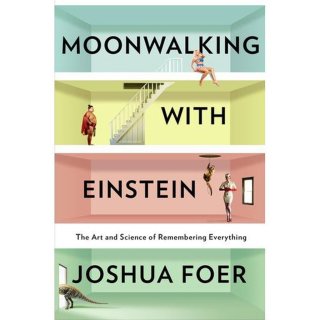
- “I did discover one intriguing candidate who was, if not the smartest person in the world, at least some kind of freakish genius. His name was Ben Pridmore, and he could memorize the precise order of 1,528 random digits in an hour and— to impress those of us with a more humanist bent— any poem handed to him. He was the reigning world memory champion. Over the next few days, my brain kept returning to Ben Pridmore’s. My own memory was average at best. Among the things I regularly forgot: where I put my car keys (where I put my car, for that matter); the food in the oven;”
- “With a memory like Ben Pridmore’s, I imagined, life would be qualitatively different— and better. Our culture constantly inundates us with new information, and yet our brains capture so little of it. Most just goes in one ear and out the other. If the point of reading were simply to retain knowledge, it would probably be the single least efficient activity I engage in. I can spend a half dozen hours reading a book and then have only a foggy notion of what it was about. All those facts and anecdotes, even the stuff interesting enough to be worth underlining, have a habit of briefly making an impression on me and then disappearing into who knows where. There are books on my shelf that I can’t even remember whether I’ve read or not.”
- “To the extent that experience is the sum of our memories and wisdom the sum of experience, having a better memory would mean knowing not only more about the world, but also more about myself. Surely some of the forgetting that seems to plague us is healthy and necessary. If I didn’t forget so many of the dumb things I’ve done, I’d probably be unbearably neurotic. But how many worthwhile ideas have gone unthought and connections unmade because of my memory’s shortcomings?”
- “Buzan was eager to sell me on the idea that his own memory has been improving year after year, even as he ages. “People assume that memory decline is a function of being human, and therefore natural,” he said. “But that is a logical error, because normal is not necessarily natural. The reason for the monitored decline in human memory performance is because we actually do anti-Olympic training. What we do to the brain is the equivalent of sitting someone down to train for the Olympics and making sure he drinks ten cans of beer a day, smokes fifty cigarettes, drives to work, and maybe does some exercise once a month that’s violent and damaging, and spends the rest of the time watching television. And then we wonder why that person doesn’t do well in the Olympics. That’s what we’ve been doing with memory.””
- “The externalization of memory not only changed how people think; it also led to a profound shift in the very notion of what it means to be intelligent. Internal memory became devalued. Erudition evolved from possessing information internally to knowing how and where to find it in the labyrinthine world of external memory. It’s a telling statement that pretty much the only place where you’ll find people still training their memories is at the World Memory Championship and the dozen national memory contests held around the globe. What was once a cornerstone of Western culture is now at best a curiosity. But as our culture has transformed from one that was fundamentally based on internal memories to one that is fundamentally based on memories stored outside the brain, what are the implications for ourselves and for our society? What we’ve gained is indisputable. But what have we traded away? What does it mean that we’ve lost our memory?”
 Tarek Naim's Blog
How nice is it to come across a fare statement like ” normal is not necessarily natural “…
music to my ears !!
Look at the norm of our time ..
Natural does not define our norm whatsoever ,
In fact the norm seems so artificial or in other words “synthetic “, may be even “robotic “!
Are we programmed ?? by technology , by the norm of our society …etc..
???
There should be no standard rules of “norm”
Whats norm for one person may not be norm for another ..
It’s relative !
And only if it’s that way .. norm can be natural .
This really does seem to be a pleasurable book to read ..
Almost like it’s naturally funny !!
Einstein forgets where he left his keys ! Reassuring ..
Anti Olympic training to the brain ..!!
It really is the case , perhaps the norm of many..
LikeLike