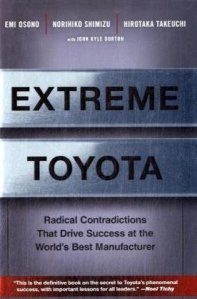
- “After six years of research into Toyota, with unprecedented access to its people and plants, three professors at Hitotsubashi University, one of Japan’s top business schools , have decided Toyota’s secret is more complex than has been assumed. Indeed, they found it like peeling an onion but never getting to the centre.
They were baffled by their many conflicting observations – the contradictions they found in a company known for operating smoothly. The breakthrough came when they realized the contradictions weren’t accidental and weren’t a problem for Toyota.
“We realized the company actively embraces and cultivates contradictions instead of passively coping with them. Toyota actually thrives on paradoxes; it harnesses opposing propositions to energize itself,” Emi Osono, Norihiko Shimizu and Hirotaka Takeuchi write in Extreme Toyota.
That title arises as the authors feel Toyota is striving to remain “extreme” – in a state of disequilibrium where radical contradictions coexist. Its leaders push the company away from any comfort zone to create healthy tension and instability, which moves the company forward.” - “Akio Matisbara recalls:
“If you’re in charge, you must be the best judge because others are less knowledgeable than you. However, you can’t make sound judgments if you’re ignorant [of the situation], so you have to survey the environment and [established] benchmarks and gather a broad range of information, and don’t just swallow it whole. You have to use your head to think it all through and arrive at your own understanding. I like to instill this culture of thinking in every young employee when they are choosing a direction or making a big decision.1 Our interactions with Toyota people around the world over a six-year period have convinced us that this practice is firmly imprinted in its employees.”
After interviews with over 220 people, we have found the common characteristics at Toyota to be an enthusiasm for making improvements, a readiness to listen and learn from others, to go to the source or genba to grasp the essence of a problem, an emphasis on teamwork, and the desire to take action quickly to solve a problem. We have also found that the people at Toyota who have come up the ranks to reach senior executive positions are generally modest in character and humble about their capabilities, personifying the old Japanese adage that the head of an abundant rice plant hangs down.” - The value of taking action is passed on through generations in popular phrases such as: “If you’re 60 percent sure, take action” or “It’s better to fail doing something than doing nothing.” What matters more than the results is the “process” of taking action to achieve results. “Otherwise, tradition tells us there can be no development of people and no fair evaluation,”
- In today’s shareholder-driven business environment, companies are expected to focus resources on productive activities and divest or close underperforming business ventures. In a mature industry, where growth is low or stagnant, companies can grow by reallocating underutilized capital and personnel resources into areas where there is higher growth potential. Earnings are used to diversify for future growth and are paid out as dividends to shareholders. The process of diversification and improvements in efficiency creates redundancies in the form of employees whose skills no longer match current or future needs or facilities that are no longer useful, and these are released back into the market. Employees are retired or laid off, and assets are sold to other companies that need those resources. The aim is to run as efficiently as possible. At Toyota, this process is reversed. Toyota plows most of its profit back into existing operations. It does not diversify much, nor does it pay a substantial dividend to shareholders, and redundant employees are trained and reassigned, not laid off. Toyota Chairman Fujio Cho explained why Toyota is a breed apart from its peers:
“Every top executive at Toyota has experienced many failures. If someone fails, they are expected to fix it by themselves, and they are not supposed to repeat the same mistakes. If employees fail, they will be scolded but their careers will not be negatively affected. We have to waste resources by trying many things when we are unsure which are best. This idea comes from our predecessors in the company. Toyota does not skimp on R&D expenditures by betting everything on one technology. Everybody at the top seems to agree on this. However, the biggest difference between Toyota and the other companies is the way Toyota spends money. Toyota focuses on the long-term potential. Other companies might not want to do this because their priority is to keep their shareholders happy” - “Always set your objectives high. If it is only a 5 percent or 10 percent improvement, people will stop challenging. At the same time, you need to know where reality stands. In a human being, you can measure reality in terms of your current height, weight, and how the heart or the lung is functioning. For an overseas operation, that could be the current level of productivity, the defect ratio on quality, or the depreciation rate. Knowing where reality lies and how high the target has been set, you can measure the gap and ask yourself how the gap is going to be filled and how long it may take to fill that gap”
 Tarek Naim's Blog
Touches on some key points of success in workplace
LikeLike